]]>Elephants never forget. You know why they say that? It’s because when elephants are born into domestication, they are immediately put into a cage or a box or bound by rope or chains or whatever other way a human being sees fit to make sure the baby elephant stays where a human being decides it should be. The baby elephant tries, with all its might, to break free from the bonds or the enclosure but to no avail because it is too weak and small. Once the baby elephant tries and fails, it will never try again for the rest of its life. That is why full-grown, adult elephants can be kept in cages or boxes or bound by rope or chains that they could easily break. An adult elephant is powerful enough to knock over a building without much trouble but it doesn’t attempt to break the bonds that it failed to break as a baby elephant. Poor elephants, they never forget.
Some human beings are like that.
Pretend there is a man named Harold Mayonnaise.
Carrier of a current Pennsylvania driver’s license, 2 credit cards, a movie rental card, a frequent visitor card for a local submarine sandwich shop, an ATM card, three photographs; his mom, his sister, who he hasn’t seen in 4 years and his wife, Marla and a folded 2 dollar bill. 37 years old. Middle school Social Studies teacher. Taller than average. Brown, thinning hair. Glasses. Americanly overweight. Slightly uneven beard. Quiet. Shy. Introverted. Modest. Passive. Indecisive. Well-read. An extra in the movie of life.
Before yesterday, he was not much different than an elephant. No one could say exactly when but sometime, somewhere, while growing up, Harold tried to get what he wanted and failed. All these years, he never tried again until yesterday.
Here’s what happened yesterday:
Saturday was the day Harold did laundry. This particular Saturday, the washing machine wasn’t working properly. He filled it just the same as every Saturday, poured in the detergent just the same as every Saturday, set the dials just the same as every Saturday but when he closed the lid, nothing happened. This was different than other Saturdays. It was as if the machine had died in its sleep during the week.
Harold called the appliance repair man but was notified that a week from Wednesday would be the earliest he could have someone come out and take a look at the dead machine. This was a terrible inconvenience, Saturday was laundry day and that would mean that at least two whole laundry days would have to pass before someone even looked at the machine. Harold was frustrated but he didn’t want to make a fuss. “O.K., then,” he said “thank you very much.” This was a very normal mantra for Harold to break into when someone said something he was unhappy about.
“O.K., then, thank you very much.” “O.K., then, thank you very much.” O.K., then, thank you very much.”
As a young man, Harold would have to force the words from his mouth. He’d often want to say something like “Bullshit! I’m not going to stand for that!” but suspected that such an outburst would do no good. He assumed that the person had already decided on whatever it was that was to be decided, there was no reason to cause a scene. So he bit his lip and spit out these words, “O.K., then, thank you very much.”
Now, after years upon years of reciting, the words tumbled out of his mouth as easily as air through his nostrils. He didn’t even hear the words as he spoke them and he certainly didn’t think about their definitions or the message they represented when strung together. There simply were no other options to consider. It had become a reflex.
The last thing Harold wanted to do yesterday was gather the week’s dirty laundry, stuff it into the car, a 1992 Honda Accord with AM/FM radio and tape deck, and drive to the local laundromat. Even less appealing was the idea of sitting there, in a foreign place, for at least an hour and a half to guard his clothing. But he had no choice, Saturday was laundry day, it always had been.
It took Harold a moment to remember where the closest laundromat was. He was fairly certain that there were plenty of them around but he never took notice as to just where. The laundromats were all just lumped together in his mind along with the check cashing establishments, shoe repair shops, veterinarians, beauty supply stores, beer distributors and all the other places of business that Harold had no use for. It was a collective blur of store fronts that took up space in the strip malls and shopping centers between the stores that Harold was interested in. Laundromats were for other people, people who didn’t have washers and dryers in their home, not for Harold, until yesterday.
“I think there is one next to the video rental store”, Harold said to himself without using his voice. He loaded up the car and pointed it slightly left of the video store. It was 10:32 AM, August 8th, 1998, although the clock in the car read 9:35. Harold never thought to alert the car of daylight’s saving time so it was only correct half of the year, there’s no explanation for the three minute discrepancy.
Harold was right, there was a laundromat next to the video store. He thought so.
This is what Harold thought to himself when he entered the laundromat:
“God, what an aesthetically unappealing place. I guess they don’t care much about atmosphere in laundromats. I guess people just go to the one that is closest to them, but the same could be said about convenience stores and they aren’t so boring and ugly on the inside. I’m hungry. Which machine should I use, I guess this one is as goo-, wait those over there look newer, may as well go for one of them. The clothes still have the detergent on them, do I need to add more? I guess it wouldn’t hurt to add a little bit more.”
A few seconds and four quarters later, the washing machine was busy removing the dirt and sweat and food that had accumulated on Harold and Marla’s clothing and towels in the past week. The washing machine didn’t know exactly where the dirt and sweat and food were so it had to wash every last inch of every article, but it didn’t mind.
The machine told Harold “24”, via a digital display screen. Harold sat down on a green plastic chair connected to a whole row of green plastic chairs and looked at the other people in the laundromat. They were as ugly as the laundromat. The machine told Harold “18”. Harold stood up to stretch his legs then sat back down. About the time the machine told Harold “15”, a drunken man walked in to the laundromat. He was tall and drunk and wearing a tuxedo.
The man had a large bundle of laundry wrapped in a bed sheet tucked under his arm and a mustache. He pushed the bundle into a washing machine and the machine told him “24”. The man sat down next to Harold and asked him his political affiliation. Although Harold couldn’t think of a specific reason why giving the mustached man an answer could be dangerous, he suspected there was one and pretended not hear him. Discouraged, the mustached man suggested that Harold should go to hell and then he laid down. The man took up three green plastic chairs. Harold continued to sit properly in his green plastic chair.
By the time Harold was finished imagining the circumstances that resulted in the mustached man ending up in the laundromat, in his condition and dressed as he was, Harold’s machine told him “1”. Harold stood up and walked towards the machine in the same way that an anxious elevator rider takes a step toward the closed doors as it approaches the desired floor. The machine told him “0”, and turned itself off.
There’s no interesting way to say that he opened the lid, gathered the clothes and towels and walked to a dryer, but it doesn’t mean it didn’t happen. It did.
The same can be said about Harold waiting for his laundry to dry. Here’s the interesting part, though:
As Harold unloaded the dryer he noticed something, there was a long black stain on a pair of Marla’s slacks. It resembled a stain Harold saw on television once created by someone brushing up against a bicycle chain. Harold assumed that the washing machine had not done its job properly and hoped that it didn’t miss any other stains. To his dismay, Harold noticed a similar stain on one of his gym socks. He wasn’t sure how such a stain might have possibly found its way to Marla’s slacks while she was wearing them but it was surely possible. Harold’s gym sock was another story. He was certain that he did nothing while wearing his gym sock to deserve such a stain.
He continued to examine the load. His white button down shirt had a black stain. Her bra had a black stain. Her vest had a black stain. A bath towel had a black stain. His boxer shorts had a black stain. Even the old T-shirt that Harold used in the garage as a rag appeared to have a new black stain. Every article seemed to have a black streak across it somewhere except a sweatshirt that said “It’s better in the Bahamas” across the chest and this offered little consolation.
A colleague of mine has created her own place to share her ideas and perspectives about education. BRAVO.
]]>
16 years ago, a silly little 7th grade student made this silly little doodle of me as a teacher/crime boss. Now he’s a power lifter who taught me more, in three paragraphs, than I learned in grad school.
“Poor is the pupil who does not surpass his master.” – Leonardo da Vinci
]]>Rhetoric, Reasoning, and Critical Thinking used to be taught as part of primary education, the obvious basic foundation for any further study. Those fundamental intellectual dimensions are now circumvented almost entirely, and it’s reflected in our society {see my art teacher/philosopher friend Todd Marrone’s The Necessity for Metamorphosis in the American Education System.
You should not have to explain to an adult, for example, what a “straw man” or “ad hominem” argument is in order to assert that their argument is guilty of it {to call bullshit in Murica terms}, but that is in fact the case. The ability for most adults to think in an independent, methodical, fluid, goal-directed manner is ABSOLUTELY CRITICAL to the health of a complex society. Not having this capacity is crippling to the development of practical intelligence and functioning, and results in susceptibility to the cookie-cutter, follow-the-leader, groupthink bullshit that tragically characterizes our culture.
Modern politics in particular relies entirely on mass ignorance of basic reasoning as well as a carefully-cultivated public gullibility. It takes only the most basic, straightforward, motive-conscious, loose detective work to plainly see that the government is controlled by an oligarchy of bankers, but this is sadly beyond the ken of the average citizen, because they have not been taught or encouraged to think for themselves. They’re assured that it’s a simple case of Donkeys vs. Elephants and that’s it. I’ll go as far as to say they’re deliberately prevented to think critically, because that’s dangerous. As long as they can blame everything on the opposing political party, everything makes sense to them and they’re limited to aimless, irrelevant bitching. Think for yourselves.

Computer Embellished Drawing
Here’s a graphic that I made for last spring’s TEDx presentation, There’s Not One Correct Answer. The image and speech is closely aligned with my recent yammering about high-stakes standardized tests and the state of our state’s Department of Education Stagnation. If you think it would make a lovely tee shirt, drop me a line and we’ll figure out how to make lovely tee shirts out of it.
In doubly-related news, my shirt-printing, music-making pal, “Handsome” Ron Foligno, cooked up a song in the same vein.
]]>I hope you don’t mind that I join the conversation regarding the proposed cutbacks of art, music, PE and foreign language at Belmont Hills (and other elementary schools). I’m the 7th grade gifted teacher at Welsh Valley Middle School Prior to that, I served as an art teacher for 15 years. I’m also an artist, designer, homeowner and father of two. My oldest will be heading to BH this fall. Consequently, I’m very invested in the issues that you’re concerned about and appreciate the community’s rally of support. My wife was in attendance last evening and mentioned that a recurring, unanswered, question continuously popped up; “Why is this happening?”
As I stated during last month’s school board meeting, I believe almost all district decision makers agree with our concerns and position. Consider this, you would be hard pressed to find a more education-friendly school board in the entire state. Our board members, many of whom I’ve worked along side of on arts related initiatives, are passionately committed to maintaining and promoting intellectual and cultural enrichment experiences. In fact, I think most would openly and proudly describe themselves as “liberal,” a word that is considered taboo in many other communities around PA.
The same can be said about central and local administrators. Believe me when I tell you, these are people who value the arts and humanities. Within the last two years, I have personally been involved in a district-wide art show that showcased the talents and accomplishments of LMSD art instructors, a promotional video specifically highlighting the contributions and impact of LMSD’s interdisciplinary programs, music, art and foreign language departments, the installation of a monumental mosaic mural and countless opportunities (digital, print, PR, presentations etc.) to highlight and celebrate student achievements in the arts. These were all initiated by central and local administrators, in an effort to build stock and value in the things we prize.
Mind you, I’m not stating this because I work for these people, I sincerely believe they deserve acknowledgement for their efforts. I’m also not saying you have to agree with, nor even like, any of them. I’m just attempting to communicate that these groups are sympathetic and supportive. It’s one thing to establish what the problem isn’t, it’s another thing to attempt to isolate the salient issue(s). I’ll try to outline what I believe them to be:
1) We have a swelling student population. Increased enrollment is, inevitably, going to lead to burdens on resources (time, energy, money). It’s unfortunate but, I suppose, that’s what you get for having a strong reputation as a premiere public school district. Our property values certainly benefit from this reputation.
2) We live in litigious times and our community is more litigious than most. Increasingly frivolous lawsuits take a tremendous toll on district resources (time, energy, money).
3) The greatest threat to the humanities is the ever increasing emphasis placed on high stakes, standardized test results, in spite of their decreasing relevance in the age of information. PSSAs were bad, Keystones will be worse. Why? Because they are going to be tied to graduation requirements AND teacher evaluations. I ask you, how can a district possibly justify committing dwindling resources to subjects that aren’t tested? Administrators’ and teachers’ livelihoods will be attached to these test results. If kids don’t do well, educators will lose their jobs and, families will eventually begin to sue the district for negligence.
How many years do you think it will take a high-stakes test-driven model to completely disenfranchise students, break quality educators and bankrupt districts? Maybe three? Then what? Voucher systems and private takeovers will seem like a great alternative, because privately run schools don’t need to play by state rules and regulations. They can make decisions based on what’s good for students instead of students’ test scores. Why would the state move in this direction? I don’t want to get too political but I will tell you that there are private individuals and organizations that stand to grab lots of local tax dollars if, and when, education is privatized. Coincidentally, they donated generously to our current governor’s campaign (and produced the documentary Waiting for Superman).
So, what can be done? As a taxpayer and parent, I’m standing up against high stakes test-centered legislation. Objective test data can certainly be one prong of assessment but there can, and should, be many others. I also intend to speak out publicly and vigilantly against, what I believe are, frivolous lawsuits which are, essentially, stealing resources from all children to benefit just a few (not to mention law firms).
I don’t intend to tell anyone what to think nor do. I merely wanted to share my perspectives which, thanks to my position and experience, may help to shed light on the subjects at hand. Sorry to have bent your eyes, keep fighting the “good fight!”
—
TODD MARRONE
www.toddmarrone.com
I went back to middle school. On purpose. Not just any middle school, but the very halls in which I lived out my sixth-to-eighth grade career. And what did I do? Observe other, smaller, people live out their sixth-to-eighth grade careers. I followed my former art teacher (now the ‘gifted’ teacher for seventh graders) around, migrating from class to class on a mission. The man formerly known as “art teacher Todd Marrone” has a proposal: revamp the state of classroom education to motivate kids to care about their learning. Tall order.
Marrone writes of an alternative plan for student motivation, saying, “If an individual is not interested, invested and/or personally accountable for achieving a goal, he or she will only move forward under the immediate supervision and intimidation/encouragement of someone who is. [This] model is an inefficient use of resources, shortsighted and unauthentic. The moment the supervisor is removed from the equation, the motivation dissipates.” Ironically, he brought me in as a kind of “supervisor” to observe his teaching, to take notes and realize possible alternatives.
I watched two classes of note. The first began with Marrone talking about eighteenth-century boats. It ended with a crowd of seventh graders singing Fleetwood Mac under their breath and discussing the logistics of parallel universes. Kids these days, eh? What happened in between is inessential – the moral of this story is that it made kids think. Too often we see rote memorization of facts lost with the conclusion of a test on the subject, but real cohesive thought isn’t a number or a name fading with time.
He let me teach a class – should I be admitting that? It doesn’t feel kosher. But I digress. It started in the same place (boats) and followed similar thematic lines, but concluded with a discussion of the ethics of cloning and the definition of personhood. Let me reiterate that these are seventh graders. Thirteen-year-olds. All of whom are capable of real intensive thought and are perfectly able to direct their own discussions and go beyond the aggregation of facts. Granted, they were seventh graders at a middle school in the Main Line, most of whom having grown up with two college-or-higher-educated parents and few (if any) financial issues. I can’t propose this system for every school – the Philadelphia public school system would benefit greatly, but is currently a complete mess and has too many current issues to overcome. Theoretically, the students should come first, but its current state sadly would not allow for these kinds of lessons.
“These kinds of lessons” just described were lecture-based ones, with a teacher standing in front of the class guiding a discussion. They’re not even at the heart of Marrone’s proposal. He wants a program in which “the students will assume the responsibility and accountability of their own, and the group’s, success by owning the authentic consequences of their choices and actions (or inaction).” An example: we moved to a classroom where, as promised, the kids would “teach themselves things we [teachers] never could.” The class was given notecards and scissors. We said, “Build something tall.” They built. They tried teams and individual work, stacking and folding and notching cards. One boy took the candy we promised vaguely as a ‘reward’ and hid it in his pockets, then confessed and gave it out to his classmates. He kept it no secret though; this boy openly let his teacher know that he had taken it from the table, seeking praise for his ingenuity, then sat at the table and offered advice on building. Occasionally the students would quiet each other, effectively monitoring their own behavior.
When they’d finished, Mr. Marrone had a list of the things he’d noticed in their work: diplomacy, politics, creativity, collaboration, leadership, negotiation, engineering, visual/spatial design, compromise, competition, etc. There were 23 items. How long would it have taken a teacher to enforce all of these? One child said “five hours,” another, “three years,” and another claimed that there was no lesson learned – only examples. This is the kind of thought we are looking for. Children should be examining their classroom activities and participating actively, so as to make a better environment for all involved. Why not include students in their own learning processes? Reconsider standardized testing. As Marrone wrote on his site, “Success isn’t a letter on a piece of paper, success is deciding on mutually beneficial solutions to problems and achieving authentic goals.”
]]>Intrinsic motivation has infinite advantages over extrinsic motivation. If an individual desires to achieve a goal, that individual will use all of his or her available resources in a pursuit to realize that goal. If, however, an individual is not interested, invested and/or personally accountable for achieving a goal, he or she will only move forward under the immediate supervision and intimidation/encouragement of someone who is. The latter model is an inefficient use of resources, shortsighted and unauthentic. The moment the supervisor is removed from the equation, the motivation dissipates.
I believe, and am willing to prove, that a group of young people can and will achieve great things when intrinsically motivated and held accountable for one another’s success and happiness. How?
THE PROPOSAL
The Lower Merion School District’s student to professional staff member ratio is roughly 11:1 Another instructor and I will assume the responsibility of 22 8th grade students. In turn, the students will assume the responsibility and accountability of their own, and the group’s, success by owning the authentic consequences of their choices and actions (or inaction). Beginning on the first day of school, they will have access to the “core” curriculum textbooks and accompanying workbooks, handouts, packets etc., as well as laptop computers with internet access. They will chose how they would like to achieve the following goal: 100% of the students will score a 90% or above on all curriculum-aligned, text book supplied unit assessments. They must, as a group, further exhibit a practical understanding of the curricular information in a way they deem most appropriate. That exhibition will be evaluated by the program instructors, in tandem with ANY stakeholders who are interested in joining the evaluation panel. I contend that they will be successful at achieving this goal in a fraction of their school year.
Once all of the students prove mastery of content in these two ways, we begin the second phase of their 8th grade learning; existential, group-selected learning experiences beyond the confines of the classroom and school campus. This could include, but is not limited to, exploratory trips to cultural, industrial, educational, professional and/or natural locations, solving real-world problems and/or passionately pursuing a group-determined goal. The possibilities are literally infinite.
WHY THIS WILL WORK
This model will work for the same reasons that a runner will inevitably beat someone being dragged, carried or pushed by another in a race. Students will be tremendously motivated to master content, spurred by their accountability to teammates and intrinsic desire to move on to phase two’s unique experiences.
COST
The budget of this pilot program will be consistent with other traditional models of instruction. It will include the use of a single room (or nontraditional space) on campus, laptops and curricular materials for the first phase. It will require access to a small bus and driver for the second phase. The students and instructors will supply the rest. If additional funding is required to achieve a goal, the group will brainstorm strategies to procure the necessary funds (and any other resources) and then attempt to do so. If they’re successful, we’ll move forward. If they can not collect the necessary resources to achieve a goal, the group will be forced to rethink or adjust the goal and/or definition of success. So goes life.
PERSONNEL
I believe I’m well-suited to pilot a model such as this because I am certified in art, secondary English and secondary social studies. Further, I have diverse interests and accomplishments in a variety of fields including the fine arts, entrepreneurship, writing, sales, performance, technology and philosophy. I am requesting a female counterpart (for gender equity) who exhibits flexibility, optimism, compassion and multicultural awareness and holds certifications in science, math and technology.
EDUCATIONAL ACCOUNTABILITY
Students will participate in the same standardized assessments as their grademates. Throughout the school year, formative and summative assessments will be used to measure student retention of core curriculum. If the program facilitators observe a deficit, group resources will be redirected towards addressing that deficit. Parents, administrators and other community stakeholders are encouraged to join us to observe any and all activities. Detailed accounts of our experiences will also be available to read about and/or view online.
STUDENT SELECTION
Any 8th grade student will be eligible for participation. Applicants must submit a one paragraph essay stating why they would be an asset to the program and their teammates based on flexibility and accountability. Applicants will be narrowed, interviewed and selected by the program facilitators. The selection will be based on the professionals’ opinions of potential benefit to the student participants, program and school community. Professional decisions will reflect the diverse population of the district, be final and defensible.
FAQ (Answered from Within the Proposed System)
Q: In phase one, what happens if one or two kids can’t pass the test(s)?
A: We, as a group, will use our resources to solve that problem. Classmates and instructors will focus our energies into helping the struggling individual(s) to isolate and overcome their obstacle(s). This is not a zero sum model, we thrive as a pack or not at all. ALL student will be asked, “what have you done and what are you willing to do to help your teammate(s) address the issue?”
Q: How will students be held accountable in phase two experiences?
A: Rather than restrict and reject modern day technology, we intend to embrace it. Students will be encouraged to use their own smart devices and other technology to chronicle and share their progress and experiences. At the conclusion of every day, students will post a reflection of the day’s events and what it meant to them and their learning. They are “responsible for information” in the traditional sense, they are responsible for what the information or experience means to them.
Q: What if students use technology to goof off and/or cyber bully?
A: Eliminating or restricting the means of making a bad decision does not eliminate the motivation to make a bad decision and, in fact, only fosters ignorant decision making. We will help students understand the consequences of their decisions and trust them to make ones that are best for themselves and others. A short discussion on the topics of delayed gratification and empathy are infinitely more effective than bans on technology.
Q: What about grades?
A: Grades are abstract, extrinsic motivators. They are a dangling carrot, and rotten one at that. Success isn’t a letter on a piece of paper, success is deciding on symbiotic, mutually beneficial solutions to problems and achieving authentic goals. A successful life inarguably involves happiness, productivity, purpose and meaning. Paper is fleeting.
Q: This sounds like a dream come true, what are the drawbacks?
A: They won’t look forward to weekends as much.
I’M SOLD, NOW WHAT
Encourage district decision makers to pilot the program I’ve outlined. We are 100% confident in the power of young people to immediately begin to achieve their goals and are willing to set the table for, and act as catalysts in, their ultimate success. Advocate.
Before a successful decision can be made in any field, one must first define success and defend the criteria for the evaluation of that success. The seemingly obvious task of education is to prepare a young person for a successful adulthood. This, of course, begs the question what is successful adulthood? Psychologists, philosophers and economists may disagree on the topic of successful adulthood but, for practical purposes, let’s define it as a happy, productive individual who leads a life of purpose and meaning. What that looks like, exactly, is up to the individual.
It should be the educator’s and/or educational system’s task to prepare a young person for a successful adulthood by moving them towards that ultimate goal with the greatest level of efficiency, to maximize the quality of their investment of time and energy, and to flexibly nurture choice and diversity, dependent on the individual’s interests and aptitudes. Our current system does neither.
WHY THE CURRENT SYSTEM IS FAILING
Any educational historian will tell you that the American Education System was created to relay information, teach left-brain thinking skills (prized by Anglo Saxons due to their history of farming, domestication of animals and, consequently, ownership) and to indoctrinate young people into loving their new nation. The residual effect of these goals is manifested in the daily pledge, the inequitable focus on, and sensationalism of, American history and the inequitable focus on “the three Rs,” (reading, writing, arithmetic)… the irony begins. Teachers lectured because books were not readily available, a tradition that has LONG outgrown its justification.
In the late 1700s, during the Industrial Revolution, the system was revised to prepare young people to enter into the workforce as either a factory workers or soldiers. Consequently, the day was divided into separate subjects (by bells/whistles), with little regard for the integration or cross-pollination of knowledge and ideas, with an emphasis on obedience over decision-making and free thought. This, perhaps, was well suited for the needs of a newly industrialized nation facing military conflict that would directly impact the majority of its citizens but that, simply, is not reflective of America’s modern needs.
Not only does this system fall short of meeting today’s needs, it represents a horrendous deficit of preparing young people for the future. Why, then, has the system not grown to change with the times? I’m getting to that.
WHY THE SYSTEM HASN’T GROWN TO CHANGE WITH THE TIMES
It is probable that the majority of educators get into the field because they enjoyed their time in school, usually because they excelled. Even though they have a passion towards teaching and learning (albeit narrowly defined) and, typically, a strong commitment to young people’s success, they struggle to conceive or embrace alternatives to a system that they value and love. They typically fit the personality profile of law-abiding, law-upholding, tradition-loving, earnest, responsible citizens. They seldom question authority and are troubled, angered and/or threatened when their authority is questioned. Ironically, their heroes and the subjects of their lessons did just that… but I digress.
Administrators, typically (and understandably) advance from that pool. Consequently, they will have a similar fondness for the system and respect for hierarchical authority. I acknowledge that this is painting with a broad brush and there are, of course, exceptions to this stereotype (probably your favorite teacher). I’ll further say that this is not a criticism of the quality of such a person, these are hardworking, task-oriented, responsible, strong, caring individuals… they just aren’t, typically, agents of change. So, who gives administrators their marching orders? The school board attempts to control the budget and assure the quality of educational programs but major decisions happen at the state and federal levels. Building and district administrators have frustratingly little autonomy because they are attempting to balance the diverse needs of their demographic with the completely homogenized, standardized state and federal requirements. But shouldn’t state officials be motivated to change education with the times? No.
The state doesn’t want to give up control to allow for autonomy, bureaucrats have little regard for efficiency because it eliminates their need and politicians and lobbyists do what is in their party’s or own financial best interest, respectively. Enter standardized testing.
THE ROLE OF STANDARDIZED TESTING
Standardized testing does a few things very well. It creates an abundance of objective data, it creates a uniformed inventory of knowledge, skills and measurement, it gives the student the impression that there is one correct answer for every problem and it gives the public a sense of educational accountability and transparency. Fairly irrelevant to what we’ve already defined success to be.
Standardized testing also effectively creates a great deal of anxiety and stress, judges the success of a student, school and district based on their “performance” on a few particular days. It suggests that exploration, experimentation and failure are enemies of success, as opposed to compliments of success. It measures left-brain functionality while completely ignoring right-brain functions. It discourages divergent thinking. It implies that reading and writing are infinitely more important than speaking and listening when it comes to effective language use. It insinuates that mathematical thinking is number specific, finite, precise and exclusively expressible by a base ten system. It implies that knowledge and understanding is subject-specific and independent of other subjects. It implies that memorizing and regurgitating facts and processes is more important than creating a tangible product or alternative solutions. It prizes independent problem solving over collaboration. It virtually outlaws the use of technology. It causes teachers, parents and administrators to look at a sheet of numbers when discussing a young person instead of actually speaking to the young person. Should I go on?
Now, recognize the fact that EVERY decision is working backwards from a definition of success that is tied to success on those tests. The quality of the school, teachers, administrators, district and even property value are tied to that measurement system. This is not an over exaggeration. “Data-based instruction” simply means looking at test data to improve test scores. Sound like a recipe for disaster? Of course.
FAQ (Answered from Within the Current System)
Q: I live in a working class area and I think fine motor skills, visual/spacial intelligence and kinesthetic awareness may be more important to my son. What can be done?
A: Nothing, he will not be considered successful unless he can exhibit verbal and math skills. If he wants to live a life of a laborer, he’ll have to think of himself as a second-class citizen.
Q: My daughter loves art and wants to be an artist, what are you doing to nurture that?
A: Cutting the art program because it’s not easy to test art objectively.
Q: My son is a great musician, it’s in his blood… he’s really passionate about it. He really dislikes math though. What can we do to help him?
A: We can give him more math so he improves his standardized test scores. If that doesn’t work, we’ll have to take him out of music all together. That will make him successful.
Q: Wait, why are you forcing my son into advanced math?
A: Because last year, the kids in advanced math did better on the state assessment test… so we’re going to put more kids in advanced math.
Q: But that’s not a causal relationship, there’s an independent variable (the math aptitude of the children). How can you make decisions about math and not understand that?
A: What you just said isn’t math, you didn’t use numbers.
Q: My daughter has test anxiety.
A: Too bad.
Q: My son hates school.
A: His scores are fine, we don’t see a big problem.
Q: My daughter loves herself and enjoys life.
A: Her test scores are low, we’ll need to intervene to make her successful.
Q: Can I, as a parent, see the test?
A: No, the test cannot be seen, photographed, held, carried or even looked at by anyone except a certified test administrator.
Q: How do you become a test administrator?
A: You take a standardized certification test to become a teacher of a particular subject. Then you take a standardized test regarding administering a standardized test.
Q: My daughter has trouble focusing/concentrating in class because the subject matter doesn’t interest her.
A: Medicate her.
Q: My son has too much energy to sit still for eight hours.
A: Medicate him so he has less energy.
Q: Mr. So and So changed my daughter’s life, she adored his class and loves his subject now.
A: His students’ test results were lower than his colleagues, he is an ineffective teacher.
Q: Why aren’t students allowed to use smart devices in school? They have access to them all day long and they can be a great tool and resource if you teach them how to effectively use them.
A: You certainly can’t use them on standardized tests, so that’s not a priority.
Q: Why can’t they use smart devices or laptops on tests? They’ll be using those types of devices (and better) to solve problems for the rest of their lives.
A: If we don’t force them to memorize things, how will we be able to use standardized tests?
Q: Why did you cover up all of the posters in your room?
A: It’s necessary to do so during standardized testing. This better prepares students to succeed in an environment were they will have no access to information, similar to life prior to the 1980s.
That’s all pretty unsound reasoning if you ask me. So why don’t schools stop using standardized testing to measure the “success” of students? Well, state funding is tied to the results. If the students don’t reach AYP (Adequate Yearly Progress), the state will withhold funding. If a failing school has less resources, then what happens? It’s hard to imagine that less money will improve the situation at all so, inevitably, the school will be expected to do better with less, close or succumb to privatization. Interestingly, AYP increases every year, making it increasingly more difficult to reach. Furthermore, teachers’ evaluations and salaries will eventually be tied to reaching AYP on standardized tests. You think test driven decision-making is prevalent now? It will only get worse. It’s likely that the pressure will increase until students, teachers and administrators leave public school, suffer significant emotional and/or physical distress or become tremendously bitter, cynical and miserable. This, inevitably, will happen to the ones who care the most first. Couple that with a recent all-out attack on educators’ benefits, pay, bargaining rights and integrity, all of which has happened within the last three years (because the economy was prime for such an attack), and who will be left? What caliber of person will enter into the field of education? Once all of the bright, high quality, passionate teachers have been demoralized, broken and replaced with a decreasing caliber of professionals, public schools will be unbearable.
Now, at that point everyone will consider private schools to be superior. They aren’t tied to state funding so they’re able to make decisions about education that they think are best for students and the community, independent of the endless standardized testing data loop. Then, conservative Republican politicians will propose voucher systems and/or the privatization of the entire public school system… and people will optimistically embrace that. Why conservative Republican candidates? Because the private sector funds their campaigns and the public sector funds their opponents. The same reason that Democrats rally behind environmental issues that result in private sector regulations, but I digress. That’s right, legislators, politicians and lobbyists are willing to sacrifice generations of children AND the people who have devoted their lives to them for private capital gain. Pardon my cynicism but, welcome to Capitalism 101… you’re late.
State and federal officials are also willing to perpetuate a system that disenfranchises and oppresses minorities, in the name of political correctness, and then have the nerve to complain when they rely on government funding. Am I saying that minorities can’t be successful in school? No, I’m saying that minorities can’t be successful in our current public school system.
BRIDGING THE ACHIEVEMENT GAP
Real multiculturalism is a system that, not only acknowledges and accepts the diverse cultural traditions, practices and priorities of its subgroups but, embraces the unique aptitudes, skills and interests of each group. It is a mistake to measure the “success” or “progress” of one group of people using the definitions and criteria of another.
Like most institutions, the American education system was created by the controlling majority. Consequently, the system overemphasizes the importance of skill sets, principles and priorities inherit to, and prized by, that majority… namely left brain specific functions such as reading, writing and arithmetic. Worse yet, the dominant measurement devices, high-stakes standardized tests, require additional L-mode analytical skills to demonstrate mastery. As mentioned, Anglo Saxons flourished in Europe due, largely, to farming and their domestication of animals. For thousands of years, analytical skills (inductive and deductive reasoning) fostered this success and these skills were evolutionarily confirmed. It also created the concept of ownership because people were investing time and energy into the land and animals. These analytical skills parlayed themselves into the sophisticated creation and utilization of complex tools (machinery, advanced transportation, irrigation etc.). They were also more motivated to develop weaponry due to their need to protect their possessions.
People developing on other continents, such as North America and Africa were developing different skills, due to their roles as hunters and/or gatherers. They, presumably, excelled at skills that complimented their habitats such as keen senses, cunning, gross and fine motor skills, strength, speed and rhythm. They were not, however, equally motivated to utilize analytical skills, develop concepts of ownership, nor means to aggressively protect property. Consequently, they were easily defeated, with technological force (superior arms), subjugated, displaced and/or enslaved. Sure times have changed for the better but African Americans and Indigenous Americans will continue to fall short of the narrow, outdated, Anglican definition of success.
An interesting parallel is that of women in sports. The popular opinion is that men are better athletes than women. That’s because men were in charge for most of history and created sports that emphasize strength, speed and singular focus (one ball/puck etc.)… qualities that, as hunters/warriors, they happened to excel at. On the other hand, women have a higher pain tolerance and lower center of gravity (both related to childbirth). Consequently, they’re MUCH better at the balance beam. Men can’t even participate in that event. Women also typically have keener senses and an affinity for peripheral vision, due to their historical role(s) as child-rearers and gatherers. Imagine what sports would look like if women created the majority of them. Men would be considered inferior athletes. The reality is, inherent differences exist.
Bridging the achievement gap is not just a matter of multicultural professional staff awareness/sensitivity training. If it were, African American students, living in predominantly African American communities, with predominately African American teachers would be doing significantly better. “Data” suggests that this is not the case.
It may be possible to close the current achievement gap within the current framework but that doesn’t mean it’s worth spending the resources, energy and funding to do so. Why hammer square pegs into round holes, especially when there are so many square holes? Also, how does that make the square pegs feel about their inherent shape, a shape that has as much intrinsic value as other shapes. Perhaps I’m overextending the metaphor. Einstein famously said, “Everybody is a genius. But, if you judge a fish by its ability to climb a tree, it’ll spend its whole life believing that it is stupid.”
A slew of recent race-related lawsuits have plagued our district and many others, this is another unnecessary drain on resources. Ironically, firms that champion themselves as a civil rights advocates have taken (and intended to take) a significant percentage of money awarded to the plaintiff(s). Their actions do far more to polarize the community than unify it. Not to mention that if a case can be made that a private school placement is more appropriate for a minority student, it’s inevitably due to the fact that private schools don’t operate under the narrow definition of success imposed on the public schools by the state (via high-stakes standardized testing). They really should be suing the state, not individual districts, schools and/or educators. Passing the buck may be unsavory but you can hardly blame a bullet for a homicide.
ADD and ADHD
It’s not just minority students that are being hurt. Consider the phenomenon of ADD (attention deficit disorder) and ADHD (attention deficit and hyperactivity disorder). There certainly is a deficit between the needs, interests and sensibilities of today’s youth and a 200 year old system but why in the world would one think the problem is with the young person? They are the recent product of millions of years of evolution (or a creator, if you insist)… the system was created by a handful of Anglicans in the 1700s. Most Americans wouldn’t use a travel book that was more than two years old. If a play was so boring that audience members walked out, the director would try to improve the play, not the audience members. If a dog chews the furniture because of an overabundance of energy, the owner resolves to give the dog more opportunities to run… yet, if a young person doesn’t fit within the current education system, parents are inclined to fill them with medicine. Why, because the system worked for our great great great grandparents? With energy to spare, rapid, divergent thought patterns and an utter intolerance for things deemed to be irrelevant, it seems today’s ADD/ADHD population is better suited for today’s world than the typical model student. It’s no wonder the percentage of diagnoses soars towards the east coast, the pace of life is faster but the schools are exactly the same as they are everywhere else in the US. The system should bend to meet the needs of students diagnosed with ADD/ADHD rather than the other way around.
BETTER FOR EVERYONE
OK, so perhaps rethinking our definition of success and creating a school system that encourages and embraces twenty first century skills would benefit racial minorities and individuals with varying levels of focus, but what about the “average” kid? Good question.
Let’s examine recent educational history. George W. Bush initiated No Child Left Behind. That tied funding to state achievement tests, predominately in arithmetic and reading. Now, they aren’t necessarily bad skills to have but has anyone really built a compelling case as to how they may be connected to happiness, productivity, purpose and meaning? Has anyone even tried? I’m not sure I’ve ever even heard anyone ask the question. For generations we’ve tied our nation’s hopes and dreams to a set of skills that were most relevant before the invention of the printing press, fountain pen, calculator and computer. That’s hardly a model promoting progress.
Obama seems to have shifted the attention towards science, math and technology. A small step in the right direction but that’s only because we hope to economically compete with Asian countries. The reality is, we’ll never compete with Asian countries when it comes to manufacturing. Their population is too great and the cost of living too low. Where we can outshine other countries is in the realm of divergent thinking. That’s right, American ingenuity. That’s what made this country great in the first place. Imagine, it’s a country dominated by the bloodlines of the rest of the world’s most courageous thinkers. Most families left their native countries and immigrated here with little more than courage, ambition and unquenchable idealism. We still continue to dominate the world of invention patents, by a long shot.
It’s imperative to end the segregation of subjects. Ancient Greece, Ancient Rome and the Renaissance are the three times in history where and when humankind made the most significant progress. The desegregation of knowledge was a characteristic of all three cultures. That’s also a common thread among all of history’s greatest minds. Consider our own beloved Ben Franklin, for instance. The reality is, no real world problem has ever been successfully solved using math, art, science, language skills, history, health etc. exclusively. It’s virtually impossible to even frame the simplest of problems entirely within the realm of one discipline? Deciding how to fold a new sweater relies on a cursory, arguably innate, understanding of aesthetics, history, science and math.
We must embrace the fact that objective facts, while tidier to evaluate on standardized assessments, are not as important nor paramount as issues and ideas that lend themselves to subjectivity. There simply is not one correct answer to any problem, especially life’s most important, engaging and challenging. Humans differ from one another, situations differ from one another, the criteria for success is ambiguous. In fact, the more abstract and complex the concept, the more intrinsically compelling human beings find the topic to be. Would you feel more compelled to spend an afternoon comparing “apples” to “apples” or “love” to “selflessness?”
A system that does not evolve in a world that does is not only doomed, it impedes the natural evolutionary process of its inhabitants. Over the centuries, world religions have adopted the break instead of bend approach… and they inevitably break. There’s a reason why the word “mythology” meant “story” in ancient times but now means “false story” in modern times. Will the word “education” someday be a synonym for “fruitless waste of time?” It is absolutely imperative to examine, assess and adjust the education system based on the anticipated needs of tomorrow, not the tradition of yesterday. In fact, no other field demands more foresight.
One only needs to trust intuition, who is the preferable employee, colleague or boss; someone with superior math, reading skills and/or science knowledge (which by the way, has become the history of science in our current system, instead of the practice of the scientific method) or someone with universally applicable skills like creativity, ingenuity, critical thinking, logic, leadership, charisma and the ability to synthesize knowledge. If the answer isn’t clear, I’ll give you a hint… one of the individuals is immediately replaceable by a typical mobile phone.
]]>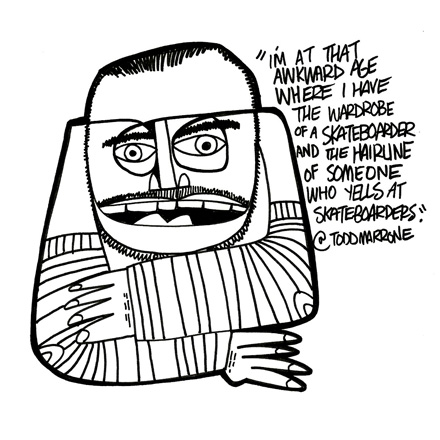

Computer Embellished Drawing
You know the old story… Guy teaches art for 15 years. Guy needs a change. Guy takes a job as a 7th grade gifted teacher. Guy struggles to make sense of it all by making ornate illustrations for his eBoard. It’s as old as the hills.
]]>