Intrinsic motivation has infinite advantages over extrinsic motivation. If an individual desires to achieve a goal, that individual will use all of his or her available resources in a pursuit to realize that goal. If, however, an individual is not interested, invested and/or personally accountable for achieving a goal, he or she will only move forward under the immediate supervision and intimidation/encouragement of someone who is. The latter model is an inefficient use of resources, shortsighted and unauthentic. The moment the supervisor is removed from the equation, the motivation dissipates.
I believe, and am willing to prove, that a group of young people can and will achieve great things when intrinsically motivated and held accountable for one another’s success and happiness. How?
THE PROPOSAL
The Lower Merion School District’s student to professional staff member ratio is roughly 11:1 Another instructor and I will assume the responsibility of 22 8th grade students. In turn, the students will assume the responsibility and accountability of their own, and the group’s, success by owning the authentic consequences of their choices and actions (or inaction). Beginning on the first day of school, they will have access to the “core” curriculum textbooks and accompanying workbooks, handouts, packets etc., as well as laptop computers with internet access. They will chose how they would like to achieve the following goal: 100% of the students will score a 90% or above on all curriculum-aligned, text book supplied unit assessments. They must, as a group, further exhibit a practical understanding of the curricular information in a way they deem most appropriate. That exhibition will be evaluated by the program instructors, in tandem with ANY stakeholders who are interested in joining the evaluation panel. I contend that they will be successful at achieving this goal in a fraction of their school year.
Once all of the students prove mastery of content in these two ways, we begin the second phase of their 8th grade learning; existential, group-selected learning experiences beyond the confines of the classroom and school campus. This could include, but is not limited to, exploratory trips to cultural, industrial, educational, professional and/or natural locations, solving real-world problems and/or passionately pursuing a group-determined goal. The possibilities are literally infinite.
WHY THIS WILL WORK
This model will work for the same reasons that a runner will inevitably beat someone being dragged, carried or pushed by another in a race. Students will be tremendously motivated to master content, spurred by their accountability to teammates and intrinsic desire to move on to phase two’s unique experiences.
COST
The budget of this pilot program will be consistent with other traditional models of instruction. It will include the use of a single room (or nontraditional space) on campus, laptops and curricular materials for the first phase. It will require access to a small bus and driver for the second phase. The students and instructors will supply the rest. If additional funding is required to achieve a goal, the group will brainstorm strategies to procure the necessary funds (and any other resources) and then attempt to do so. If they’re successful, we’ll move forward. If they can not collect the necessary resources to achieve a goal, the group will be forced to rethink or adjust the goal and/or definition of success. So goes life.
PERSONNEL
I believe I’m well-suited to pilot a model such as this because I am certified in art, secondary English and secondary social studies. Further, I have diverse interests and accomplishments in a variety of fields including the fine arts, entrepreneurship, writing, sales, performance, technology and philosophy. I am requesting a female counterpart (for gender equity) who exhibits flexibility, optimism, compassion and multicultural awareness and holds certifications in science, math and technology.
EDUCATIONAL ACCOUNTABILITY
Students will participate in the same standardized assessments as their grademates. Throughout the school year, formative and summative assessments will be used to measure student retention of core curriculum. If the program facilitators observe a deficit, group resources will be redirected towards addressing that deficit. Parents, administrators and other community stakeholders are encouraged to join us to observe any and all activities. Detailed accounts of our experiences will also be available to read about and/or view online.
STUDENT SELECTION
Any 8th grade student will be eligible for participation. Applicants must submit a one paragraph essay stating why they would be an asset to the program and their teammates based on flexibility and accountability. Applicants will be narrowed, interviewed and selected by the program facilitators. The selection will be based on the professionals’ opinions of potential benefit to the student participants, program and school community. Professional decisions will reflect the diverse population of the district, be final and defensible.
FAQ (Answered from Within the Proposed System)
Q: In phase one, what happens if one or two kids can’t pass the test(s)?
A: We, as a group, will use our resources to solve that problem. Classmates and instructors will focus our energies into helping the struggling individual(s) to isolate and overcome their obstacle(s). This is not a zero sum model, we thrive as a pack or not at all. ALL student will be asked, “what have you done and what are you willing to do to help your teammate(s) address the issue?”
Q: How will students be held accountable in phase two experiences?
A: Rather than restrict and reject modern day technology, we intend to embrace it. Students will be encouraged to use their own smart devices and other technology to chronicle and share their progress and experiences. At the conclusion of every day, students will post a reflection of the day’s events and what it meant to them and their learning. They are “responsible for information” in the traditional sense, they are responsible for what the information or experience means to them.
Q: What if students use technology to goof off and/or cyber bully?
A: Eliminating or restricting the means of making a bad decision does not eliminate the motivation to make a bad decision and, in fact, only fosters ignorant decision making. We will help students understand the consequences of their decisions and trust them to make ones that are best for themselves and others. A short discussion on the topics of delayed gratification and empathy are infinitely more effective than bans on technology.
Q: What about grades?
A: Grades are abstract, extrinsic motivators. They are a dangling carrot, and rotten one at that. Success isn’t a letter on a piece of paper, success is deciding on symbiotic, mutually beneficial solutions to problems and achieving authentic goals. A successful life inarguably involves happiness, productivity, purpose and meaning. Paper is fleeting.
Q: This sounds like a dream come true, what are the drawbacks?
A: They won’t look forward to weekends as much.
I’M SOLD, NOW WHAT
Encourage district decision makers to pilot the program I’ve outlined. We are 100% confident in the power of young people to immediately begin to achieve their goals and are willing to set the table for, and act as catalysts in, their ultimate success. Advocate.
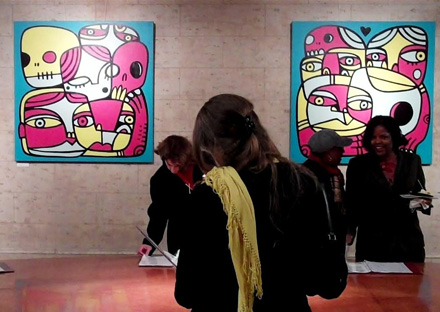
Acrylic & Enamel on Canvas • 4′x4′ • Main Line, Philadelphia
Giant works populate a giant public space, behind the public population.
]]>
Computer Embellished Drawing • Donated to Charity
Every year, the Lower Merion School District hosts a wing-eating competition to benefit the Children’s Hospital of Pennsylvania. This is great news for sick kids but terrible news for chickens.
Last year, I placed in the top five. This year, I’m hoping that my tee design will help to sway the judges.
]]>