
Computer Embellished Drawing
Here’s everything you never wanted to know I knew about the American education system. Read it over and submit a three-page report by Tuesday.
- A Manifesto (It’s admittedly involved)
- A Proposal (How I believe I’d be able to address some of the issues I outlined, on a small scale)
- A Student Editorial (A high school senior’s perspective on some of the principles I’m championing)
- An Open Letter (The state of things in our district)
- Kids on Testing

Public school education is in critical condition… and private corporations are circling above. Take a gander at one of my courageous colleague’s take on “The Common Core Kool-Aid.”
]]>A colleague of mine has created her own place to share her ideas and perspectives about education. BRAVO.
]]>REVOLUTION














REFLECTION









READING









RECYCLING










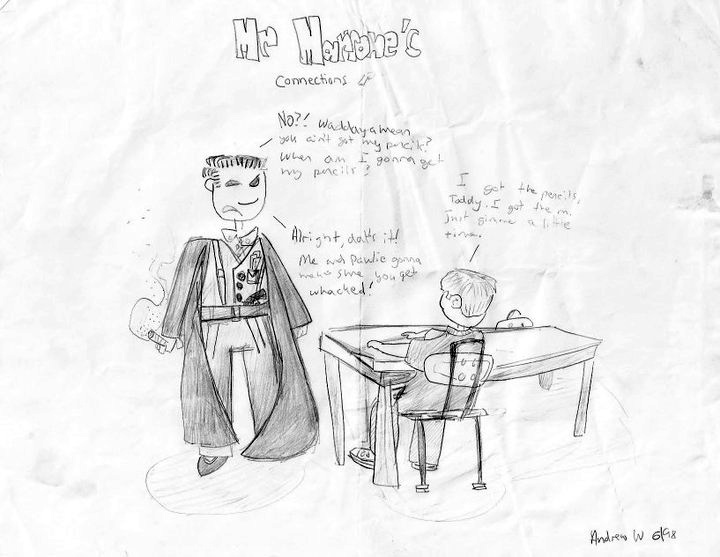
16 years ago, a silly little 7th grade student made this silly little doodle of me as a teacher/crime boss. Now he’s a power lifter who taught me more, in three paragraphs, than I learned in grad school.
“Poor is the pupil who does not surpass his master.” – Leonardo da Vinci
]]>Rhetoric, Reasoning, and Critical Thinking used to be taught as part of primary education, the obvious basic foundation for any further study. Those fundamental intellectual dimensions are now circumvented almost entirely, and it’s reflected in our society {see my art teacher/philosopher friend Todd Marrone’s The Necessity for Metamorphosis in the American Education System.
You should not have to explain to an adult, for example, what a “straw man” or “ad hominem” argument is in order to assert that their argument is guilty of it {to call bullshit in Murica terms}, but that is in fact the case. The ability for most adults to think in an independent, methodical, fluid, goal-directed manner is ABSOLUTELY CRITICAL to the health of a complex society. Not having this capacity is crippling to the development of practical intelligence and functioning, and results in susceptibility to the cookie-cutter, follow-the-leader, groupthink bullshit that tragically characterizes our culture.
Modern politics in particular relies entirely on mass ignorance of basic reasoning as well as a carefully-cultivated public gullibility. It takes only the most basic, straightforward, motive-conscious, loose detective work to plainly see that the government is controlled by an oligarchy of bankers, but this is sadly beyond the ken of the average citizen, because they have not been taught or encouraged to think for themselves. They’re assured that it’s a simple case of Donkeys vs. Elephants and that’s it. I’ll go as far as to say they’re deliberately prevented to think critically, because that’s dangerous. As long as they can blame everything on the opposing political party, everything makes sense to them and they’re limited to aimless, irrelevant bitching. Think for yourselves.
- Mr. Marrone – At last night’s school board meeting, there was a proposal to reduce art, music, phys ed and foreign language at the elementary schools. Why do you think the district would propose something like that? Do you agree with the proposal?
- Colonel Mustard – I think that they choose to do this because of the funding, which i think is crazy because they fund things that we don’t even need.
- Mr. Green – It is so they have more time to do core curriculum material.
- Miss Scarlett – And to build fences.
- Mr. Green – I think they should just make no half days or movies in school and they would have time.
- Dr. Black – I agree completely with Miss Scarlett.
-
Mrs. Peacock – I don’t think that LMSD has any problem financially. The only thing they are concerned about is the PSSA’s so they are focusing on curriculum classes. If they were concerned with money they wouldn’t have built the fence. I think this is absolutely disgusting because when you are young that is the most important time to learn about things other than core subjects-find out what things you like, like music. Cutting back on the arts is the first step to the world being controlled by robots.
- Mr. Marrone – The robots wait anxiously in the wings…
-
Miss Peach – Its all about money. They did it in my old school district. If someone would open up their wallets and donate, then we wouldn’t be in this predicament. Also they’re closing down CAPA in philly. It was a preforming arts experimental magnet school, but they haven’t produced any great talent since the 80s. Its pretty sad (that their best talent was in the 80 including Boys to Men and the Roots.) On a lighter note, I doubt that the elementary schools will loose their arts. Many parents in this community have the means to help stop this from happening.
- Madame Rose – I think that the school thinks if they devote more time to subjects we are tested on at a state level, our scores will be higher and this will result in more funds. This is the most ridiculous thing I’ve ever heard. They should know students well enough to realize that 15 extra minutes of math doesn’t equal 15 minutes of increased intelligence. I’d bet a large sum of money that that 15 minutes would be spent with eyes glazed over, wishing you could get to gym or art or another class that you enjoy more. I understand their logic but kids don’t care about standardized testing and it’s cruel to replace their favorite subjects with more prep.
- Mrs. White – That’s crazy. I don’t know why they would ever think to do something like that. Reducing art, music, gym, and foreign language would not benefit us at all and it just isn’t fair to take away those things.
- Miss Scarlett – People are all different. It is not fair that some classes that play to the different people’s strengths are cut, and the classes that they’re bad at, remain. School is about learning. But learning is not all about the basic stuff. When we grow up, chances are, we’ll need to know music or art more than say, the Magna Carta.
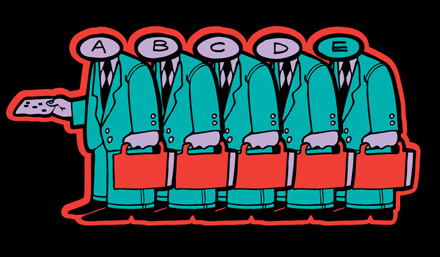
Computer Embellished Drawing
Here’s a graphic that I made for last spring’s TEDx presentation, There’s Not One Correct Answer. The image and speech is closely aligned with my recent yammering about high-stakes standardized tests and the state of our state’s Department of Education Stagnation. If you think it would make a lovely tee shirt, drop me a line and we’ll figure out how to make lovely tee shirts out of it.
In doubly-related news, my shirt-printing, music-making pal, “Handsome” Ron Foligno, cooked up a song in the same vein.
]]>I hope you don’t mind that I join the conversation regarding the proposed cutbacks of art, music, PE and foreign language at Belmont Hills (and other elementary schools). I’m the 7th grade gifted teacher at Welsh Valley Middle School Prior to that, I served as an art teacher for 15 years. I’m also an artist, designer, homeowner and father of two. My oldest will be heading to BH this fall. Consequently, I’m very invested in the issues that you’re concerned about and appreciate the community’s rally of support. My wife was in attendance last evening and mentioned that a recurring, unanswered, question continuously popped up; “Why is this happening?”
As I stated during last month’s school board meeting, I believe almost all district decision makers agree with our concerns and position. Consider this, you would be hard pressed to find a more education-friendly school board in the entire state. Our board members, many of whom I’ve worked along side of on arts related initiatives, are passionately committed to maintaining and promoting intellectual and cultural enrichment experiences. In fact, I think most would openly and proudly describe themselves as “liberal,” a word that is considered taboo in many other communities around PA.
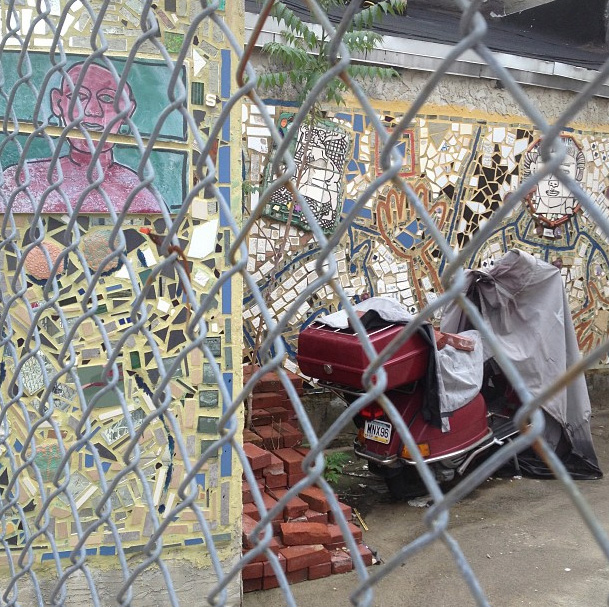
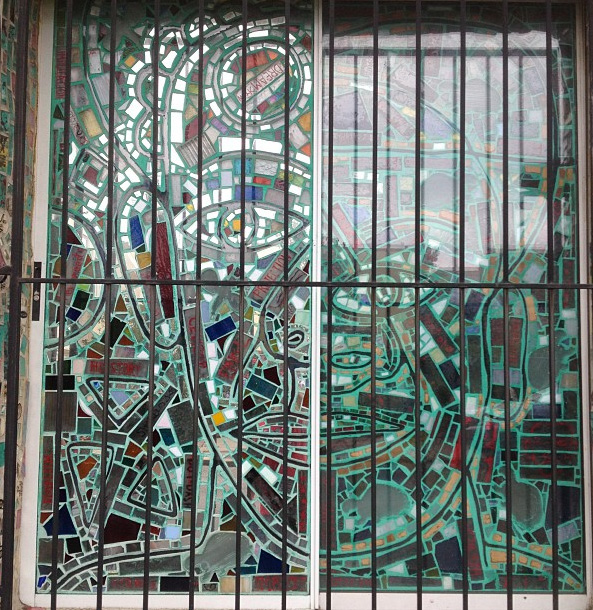
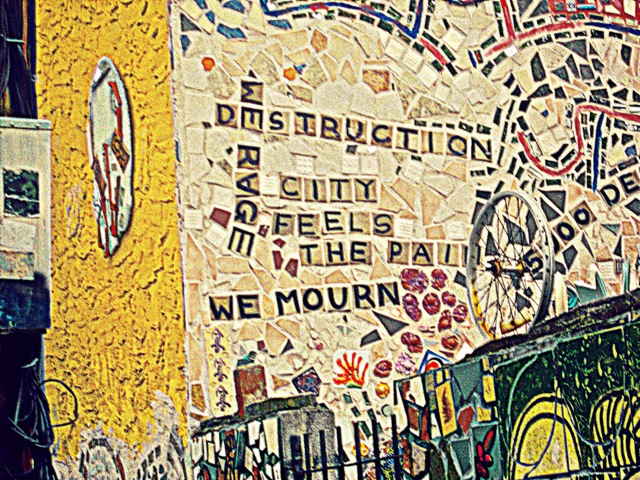
The same can be said about central and local administrators. Believe me when I tell you, these are people who value the arts and humanities. Within the last two years, I have personally been involved in a district-wide art show that showcased the talents and accomplishments of LMSD art instructors, a promotional video specifically highlighting the contributions and impact of LMSD’s interdisciplinary programs, music, art and foreign language departments, the installation of a monumental mosaic mural and countless opportunities (digital, print, PR, presentations etc.) to highlight and celebrate student achievements in the arts. These were all initiated by central and local administrators, in an effort to build stock and value in the things we prize.
Mind you, I’m not stating this because I work for these people, I sincerely believe they deserve acknowledgement for their efforts. I’m also not saying you have to agree with, nor even like, any of them. I’m just attempting to communicate that these groups are sympathetic and supportive. It’s one thing to establish what the problem isn’t, it’s another thing to attempt to isolate the salient issue(s). I’ll try to outline what I believe them to be:
1) We have a swelling student population. Increased enrollment is, inevitably, going to lead to burdens on resources (time, energy, money). It’s unfortunate but, I suppose, that’s what you get for having a strong reputation as a premiere public school district. Our property values certainly benefit from this reputation.
2) We live in litigious times and our community is more litigious than most. Increasingly frivolous lawsuits take a tremendous toll on district resources (time, energy, money).
3) The greatest threat to the humanities is the ever increasing emphasis placed on high stakes, standardized test results, in spite of their decreasing relevance in the age of information. PSSAs were bad, Keystones will be worse. Why? Because they are going to be tied to graduation requirements AND teacher evaluations. I ask you, how can a district possibly justify committing dwindling resources to subjects that aren’t tested? Administrators’ and teachers’ livelihoods will be attached to these test results. If kids don’t do well, educators will lose their jobs and, families will eventually begin to sue the district for negligence.
How many years do you think it will take a high-stakes test-driven model to completely disenfranchise students, break quality educators and bankrupt districts? Maybe three? Then what? Voucher systems and private takeovers will seem like a great alternative, because privately run schools don’t need to play by state rules and regulations. They can make decisions based on what’s good for students instead of students’ test scores. Why would the state move in this direction? I don’t want to get too political but I will tell you that there are private individuals and organizations that stand to grab lots of local tax dollars if, and when, education is privatized. Coincidentally, they donated generously to our current governor’s campaign (and produced the documentary Waiting for Superman).
So, what can be done? As a taxpayer and parent, I’m standing up against high stakes test-centered legislation. Objective test data can certainly be one prong of assessment but there can, and should, be many others. I also intend to speak out publicly and vigilantly against, what I believe are, frivolous lawsuits which are, essentially, stealing resources from all children to benefit just a few (not to mention law firms).
I don’t intend to tell anyone what to think nor do. I merely wanted to share my perspectives which, thanks to my position and experience, may help to shed light on the subjects at hand. Sorry to have bent your eyes, keep fighting the “good fight!”
—
TODD MARRONE
www.toddmarrone.com
I went back to middle school. On purpose. Not just any middle school, but the very halls in which I lived out my sixth-to-eighth grade career. And what did I do? Observe other, smaller, people live out their sixth-to-eighth grade careers. I followed my former art teacher (now the ‘gifted’ teacher for seventh graders) around, migrating from class to class on a mission. The man formerly known as “art teacher Todd Marrone” has a proposal: revamp the state of classroom education to motivate kids to care about their learning. Tall order.
Marrone writes of an alternative plan for student motivation, saying, “If an individual is not interested, invested and/or personally accountable for achieving a goal, he or she will only move forward under the immediate supervision and intimidation/encouragement of someone who is. [This] model is an inefficient use of resources, shortsighted and unauthentic. The moment the supervisor is removed from the equation, the motivation dissipates.” Ironically, he brought me in as a kind of “supervisor” to observe his teaching, to take notes and realize possible alternatives.
I watched two classes of note. The first began with Marrone talking about eighteenth-century boats. It ended with a crowd of seventh graders singing Fleetwood Mac under their breath and discussing the logistics of parallel universes. Kids these days, eh? What happened in between is inessential – the moral of this story is that it made kids think. Too often we see rote memorization of facts lost with the conclusion of a test on the subject, but real cohesive thought isn’t a number or a name fading with time.
He let me teach a class – should I be admitting that? It doesn’t feel kosher. But I digress. It started in the same place (boats) and followed similar thematic lines, but concluded with a discussion of the ethics of cloning and the definition of personhood. Let me reiterate that these are seventh graders. Thirteen-year-olds. All of whom are capable of real intensive thought and are perfectly able to direct their own discussions and go beyond the aggregation of facts. Granted, they were seventh graders at a middle school in the Main Line, most of whom having grown up with two college-or-higher-educated parents and few (if any) financial issues. I can’t propose this system for every school – the Philadelphia public school system would benefit greatly, but is currently a complete mess and has too many current issues to overcome. Theoretically, the students should come first, but its current state sadly would not allow for these kinds of lessons.
“These kinds of lessons” just described were lecture-based ones, with a teacher standing in front of the class guiding a discussion. They’re not even at the heart of Marrone’s proposal. He wants a program in which “the students will assume the responsibility and accountability of their own, and the group’s, success by owning the authentic consequences of their choices and actions (or inaction).” An example: we moved to a classroom where, as promised, the kids would “teach themselves things we [teachers] never could.” The class was given notecards and scissors. We said, “Build something tall.” They built. They tried teams and individual work, stacking and folding and notching cards. One boy took the candy we promised vaguely as a ‘reward’ and hid it in his pockets, then confessed and gave it out to his classmates. He kept it no secret though; this boy openly let his teacher know that he had taken it from the table, seeking praise for his ingenuity, then sat at the table and offered advice on building. Occasionally the students would quiet each other, effectively monitoring their own behavior.
When they’d finished, Mr. Marrone had a list of the things he’d noticed in their work: diplomacy, politics, creativity, collaboration, leadership, negotiation, engineering, visual/spatial design, compromise, competition, etc. There were 23 items. How long would it have taken a teacher to enforce all of these? One child said “five hours,” another, “three years,” and another claimed that there was no lesson learned – only examples. This is the kind of thought we are looking for. Children should be examining their classroom activities and participating actively, so as to make a better environment for all involved. Why not include students in their own learning processes? Reconsider standardized testing. As Marrone wrote on his site, “Success isn’t a letter on a piece of paper, success is deciding on mutually beneficial solutions to problems and achieving authentic goals.”
]]>Intrinsic motivation has infinite advantages over extrinsic motivation. If an individual desires to achieve a goal, that individual will use all of his or her available resources in a pursuit to realize that goal. If, however, an individual is not interested, invested and/or personally accountable for achieving a goal, he or she will only move forward under the immediate supervision and intimidation/encouragement of someone who is. The latter model is an inefficient use of resources, shortsighted and unauthentic. The moment the supervisor is removed from the equation, the motivation dissipates.
I believe, and am willing to prove, that a group of young people can and will achieve great things when intrinsically motivated and held accountable for one another’s success and happiness. How?
THE PROPOSAL
The Lower Merion School District’s student to professional staff member ratio is roughly 11:1 Another instructor and I will assume the responsibility of 22 8th grade students. In turn, the students will assume the responsibility and accountability of their own, and the group’s, success by owning the authentic consequences of their choices and actions (or inaction). Beginning on the first day of school, they will have access to the “core” curriculum textbooks and accompanying workbooks, handouts, packets etc., as well as laptop computers with internet access. They will chose how they would like to achieve the following goal: 100% of the students will score a 90% or above on all curriculum-aligned, text book supplied unit assessments. They must, as a group, further exhibit a practical understanding of the curricular information in a way they deem most appropriate. That exhibition will be evaluated by the program instructors, in tandem with ANY stakeholders who are interested in joining the evaluation panel. I contend that they will be successful at achieving this goal in a fraction of their school year.
Once all of the students prove mastery of content in these two ways, we begin the second phase of their 8th grade learning; existential, group-selected learning experiences beyond the confines of the classroom and school campus. This could include, but is not limited to, exploratory trips to cultural, industrial, educational, professional and/or natural locations, solving real-world problems and/or passionately pursuing a group-determined goal. The possibilities are literally infinite.
WHY THIS WILL WORK
This model will work for the same reasons that a runner will inevitably beat someone being dragged, carried or pushed by another in a race. Students will be tremendously motivated to master content, spurred by their accountability to teammates and intrinsic desire to move on to phase two’s unique experiences.
COST
The budget of this pilot program will be consistent with other traditional models of instruction. It will include the use of a single room (or nontraditional space) on campus, laptops and curricular materials for the first phase. It will require access to a small bus and driver for the second phase. The students and instructors will supply the rest. If additional funding is required to achieve a goal, the group will brainstorm strategies to procure the necessary funds (and any other resources) and then attempt to do so. If they’re successful, we’ll move forward. If they can not collect the necessary resources to achieve a goal, the group will be forced to rethink or adjust the goal and/or definition of success. So goes life.
PERSONNEL
I believe I’m well-suited to pilot a model such as this because I am certified in art, secondary English and secondary social studies. Further, I have diverse interests and accomplishments in a variety of fields including the fine arts, entrepreneurship, writing, sales, performance, technology and philosophy. I am requesting a female counterpart (for gender equity) who exhibits flexibility, optimism, compassion and multicultural awareness and holds certifications in science, math and technology.
EDUCATIONAL ACCOUNTABILITY
Students will participate in the same standardized assessments as their grademates. Throughout the school year, formative and summative assessments will be used to measure student retention of core curriculum. If the program facilitators observe a deficit, group resources will be redirected towards addressing that deficit. Parents, administrators and other community stakeholders are encouraged to join us to observe any and all activities. Detailed accounts of our experiences will also be available to read about and/or view online.
STUDENT SELECTION
Any 8th grade student will be eligible for participation. Applicants must submit a one paragraph essay stating why they would be an asset to the program and their teammates based on flexibility and accountability. Applicants will be narrowed, interviewed and selected by the program facilitators. The selection will be based on the professionals’ opinions of potential benefit to the student participants, program and school community. Professional decisions will reflect the diverse population of the district, be final and defensible.
FAQ (Answered from Within the Proposed System)
Q: In phase one, what happens if one or two kids can’t pass the test(s)?
A: We, as a group, will use our resources to solve that problem. Classmates and instructors will focus our energies into helping the struggling individual(s) to isolate and overcome their obstacle(s). This is not a zero sum model, we thrive as a pack or not at all. ALL student will be asked, “what have you done and what are you willing to do to help your teammate(s) address the issue?”
Q: How will students be held accountable in phase two experiences?
A: Rather than restrict and reject modern day technology, we intend to embrace it. Students will be encouraged to use their own smart devices and other technology to chronicle and share their progress and experiences. At the conclusion of every day, students will post a reflection of the day’s events and what it meant to them and their learning. They are “responsible for information” in the traditional sense, they are responsible for what the information or experience means to them.
Q: What if students use technology to goof off and/or cyber bully?
A: Eliminating or restricting the means of making a bad decision does not eliminate the motivation to make a bad decision and, in fact, only fosters ignorant decision making. We will help students understand the consequences of their decisions and trust them to make ones that are best for themselves and others. A short discussion on the topics of delayed gratification and empathy are infinitely more effective than bans on technology.
Q: What about grades?
A: Grades are abstract, extrinsic motivators. They are a dangling carrot, and rotten one at that. Success isn’t a letter on a piece of paper, success is deciding on symbiotic, mutually beneficial solutions to problems and achieving authentic goals. A successful life inarguably involves happiness, productivity, purpose and meaning. Paper is fleeting.
Q: This sounds like a dream come true, what are the drawbacks?
A: They won’t look forward to weekends as much.
I’M SOLD, NOW WHAT
Encourage district decision makers to pilot the program I’ve outlined. We are 100% confident in the power of young people to immediately begin to achieve their goals and are willing to set the table for, and act as catalysts in, their ultimate success. Advocate.