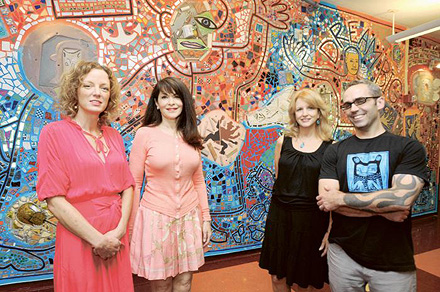
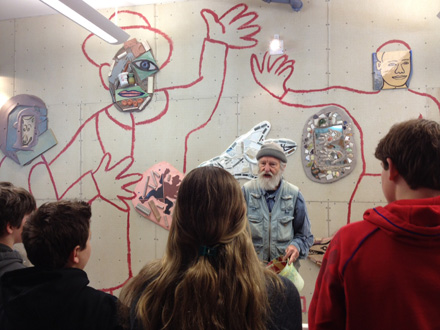
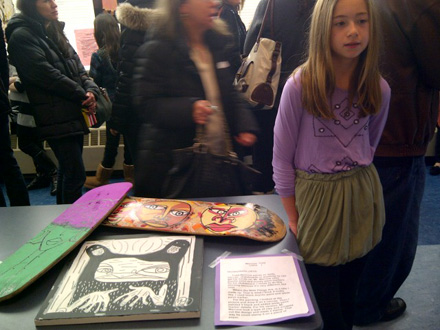
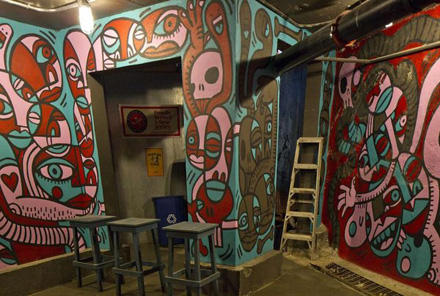
The Ghosticorn press tsunami pummeled suburban shores this week thanks to our new friends at Philly Edge. We know, we know… you’re staring at the logo.
Archive for the Press CategoryPhiladelphia Weekly features a flattering blurbicle about my clothing line, Ghosticorn Apparel, in this week’s “Pop Rocks” column. Don’t read the article while drinking soda or you’ll explode.
You can’t swing a dead cat around the the office of Philadelphia’s City Paper without being arrested for disturbing the peace. You’re also bound to hit a Todd Marrone-related article. Here’s a roundup of recent ink: Kristen A. Graham • Philadelphia Inquirer • February, 2007 Paints are plentiful in Todd Marrone’s modern Lower Merion classroom. Brushes? Pastels? Markers? Heavy, creamy paper? Available in abundance. Unlike some art teachers, who struggle for resources to keep bare-bones programs afloat, Marrone and his colleagues at Welsh Valley Middle School in Narberth are lucky. “The supplies are fabulous,” said Marrone, a Starburst-tossing, game-playing, enthusiastic teacher whose frenetic energy sometimes outstrips his students’. But Marrone, who has been teaching art in Lower Merion for a decade, wanted his eighth-grade students to embark on an ambitious project, something that challenged their perceptions, made them think of art and of themselves in a different way. Using only No. 2 pencils, the students spent two months working on large self-portraits. They drew in a quiet room with the only classroom noise the soft hum of jazz music. The key component, though, Marrone said, was the most basic of art supplies. “It’s not traditionally considered an art material, but it was especially important to me because this is the same exact material that they’re being forced to use to fill out bubbles for Scantron answer sheets and standardized testing,” Marrone said. The results of Marrone’s making his students think outside the bubble are arresting: hallways full of young teenage faces drawn carefully in black and white, grouped together tightly on the wall - students smiling, mugging, looking straight ahead, looking pensive. The process began late last year, when Marrone set students up by a window and snapped a photo of each. “Some of them looked very confident, some of them not so secure with themselves,” Marrone said. “Certain kids had braces and didn’t want to show their teeth.” Next, the students made grid scales on 20-by-14-inch paper and on their photograph and began their self-portraits - box by painstaking box, focusing not on the picture itself but on the contents of each box. There were plenty of protests that they weren’t artists, Marrone said, and that the project required too much concentration, and that the subjects couldn’t bear looking at themselves for two months. But gradually, they came around - like Ella Cohen, 13. “We didn’t think we could do it, but we did it,” Ella said with more than a little pride, pointing to the portrait she drew of herself, smiling slightly, dark hair loose around her face. “At first, I didn’t like it, but now, it’s OK.” Kristen Weigel, 14, agreed. “I’ve never worked on anything this intense,” Kristen said. Evan Opall, 13, deemed the project both eye-opening and “cool.” “You didn’t think it was going to turn out to look like you, but it did,” he said. Watching his students journey through that process was very satisfying, said Marrone, 32, himself an artist, with an edgy tattoo crawling up his arm and his classroom decorated, in part, with his own bold pop art pieces. At first, he said, students had a tough time drawing themselves - “certainly there are plenty of identity issues for young adults.” But “it stopped being them at a certain point, and it started being a collection of values and shades. It almost helped them to get past any issues, conceptually or metaphorically. The subject ceased to exist and the components that made up the image became more important.” Poses and line quality told him much about his students. “It’s like handwriting analysis, but beyond that. Certainly you can tell a lot by the pose that they chose, and how hard they press, if they’re willing to make really dark marks,” Marrone said. “We talked a lot about embracing their own style.” And they drew parallels to and inspiration from contemporary American artist Chuck Close, who struggles with learning disabilities and since 1988 has been a quadriplegic, producing his large photorealistic portraits using a paintbrush held in a wrist harness. Betsy Hurtado, 14, who loves to draw, found the project a welcome challenge - something quite different from what she typically confronts in her art classes. Pencils “are harder because they smudge really easily, and we’re not allowed to smudge them with our fingers because the grease affects the drawing. So to have to make the whole scale of light to dark with just a pencil is pretty difficult,” Betsy said. And then there was self-examination. “You see a lot of your flaws,” Betsy said. “I noticed different things - like when I smile, one of my eyes is more shut than the other.” Overall, though, Betsy was wowed by the experience. “I thought it was a good project,” she said. “I learned a lot.” “I didn’t have to encourage them to do it - they really wanted to finish. Every one of them is wildly successful,” he said.” Alicia Puglionesi • Main Line Times Newspaper • June, 2006 Some people like to sit quietly and listen to music. Todd Marrone likes to dash around the room and slather paint on giant rolls of paper. “It’s all a matter of preference,” says Marrone, a Narberth-based artist whose work, in addition to appearing in bus shelters and train stations around the region, will be on display at Milkboy Coffee in Ardmore starting July 7. For the show’s opening night, Marrone decided to eschew the traditional wine, cheese and black turtlenecks for a livelier presentation: He will paint along to the musical stylings of local band the Levelheads - thus ensuring, in his words, that “the house is properly rocked.” “When I hear music, I think about images,” Marrone explains, “and when I’m painting, I’m either listening to music, singing, humming, or thinking songs.” This passion for music makes it only natural to paint accompanied by live bands, as he has done in the past at the Theater of the Living Arts, the North Star Bar, and numerous other venues in the Philadelphia area. “As stimulating as it is to listen to concerts, there’s not much to look at,” he remarks. “This is a way of bombarding the visual and auditory senses.” A trim man with close-cropped hair and thick-rimmed glasses, Marrone doesn’t immediately strike the casual observer as a person who deals in sensory bombardment. A few telling details - a tattoo spiraling up his left forearm, for instance - hint at the edgy approach that he takes to his work, both in the studio and in the classroom as an art teacher at Welsh Valley Middle School in Lower Merion. Marrone’s philosophy of art embraces the spontaneity and energy of the live performance even when he works in relative isolation. One method he developed, using empty glue bottles to squeeze lines of paint onto paper, produces dozens of angular, gestural sketches at a sitting. “Sometimes I make them faster than I can get them onto the drying rack - and they certainly don’t sell as fast as I can paint,” he laments. As a result, many glue bottle paintings are destined to act as ambassadors of the Marrone gospel, stapled to telephone poles, benches, and bus shelters for the enjoyment of passers-by. He includes a message with each piece explaining his project and how to contact him. By no means is this a “look with your eyes, not with your hands” arrangement: Marrone wants people to take his work home with them and make art a greater part of their lives. Sometimes this requires a little nudging, as many people seem to have difficulty with the concept of free art: “It’s usually this long, drawn-out process,” says Marrone, reflecting on the times that he’s watched from a hidden vantage point to see who plucks his paintings. “They’ll read the information, then spend a few minutes deliberating - like they’re not sure it’s legit - and then grab it and walk off.” In one case, however, Marrone discovered an amateur collector at work on South Street in Philadelphia. A man passing by on the sidewalk snatched one of his freshly hung posters with hardly a sideways glance, and Marrone, intrigued by the quick response, followed him into a shoe store. “The man goes, ‘hey, I found another one of those paintings by that guy,’” Marrone recalls bemusedly. “So I asked him what paintings he was talking about, and he started explaining the concept of my work to me from what he had read on the posters. Apparently he had a whole bunch of them back in the employee lounge.” Whereas his ’street art’ is decidedly low-tech, he also has a sizable presence on the web, selling work on eBay as well as from his own site, www.toddmarrone.com. Many artists scoff at the informality of internet sales, but for Marrone “It’s all about getting your work out there. There’s no point if you’re just going to scribble in a sketchbook somewhere and keep it to yourself.” Drawing inspiration from the guerilla art of Keith Haring and the mass-produced aesthetic of the Pop movement, Marrone believes that art should be “…accessible and available. There should be art out there that’s consumable for everyone without having to go into a gallery or a museum.” He especially rails against the “elitist, exclusive tendencies of the art world,” pointing out that many people, when faced with a piece they dislike, assume that they just aren’t smart enough to understand it and keep their opinions to themselves. Certainly, Marrone has observed this phenomenon among his favorite constituency: the sixth, seventh, and eighth graders whom he teaches at Welsh Valley Middle School. Some students arrive in his class claiming that they “just can’t do art.” “I don’t have kids at the end of the school year who talk like that,” he reports with a touch of pride. “It’s not a competition about who draws best. These kids are the future of art, whether as producers, collectors, or the voters who have to make decisions about arts funding.” During the course of the year, Marrone leads his classes through a survey of basic skills and art history, with an emphasis on discussion and criticism. “I spend a lot of class time trying to make kids feel comfortable looking at and talking about art,” he says. “It’s sort of like a big commercial to try and get them enthusiastic, to make kids who aren’t great at it feel included in this world.” Marrone’s own work isn’t immune from the critical lens. Since he likes to paint in the classroom, his students have the chance to watch his pieces progress and give him some pointers. And kids can be harsh. “The most important thing is constructive criticism,” he states. “I’ve changed paintings based on their recommendations; these kids have some very sophisticated opinions.” Although they’re adept at spotting “areas for improvement” in his paintings, Marrone’s pupils seem quite happy with his teaching style: on evaluations, the most common request is that they be allowed to pick their own seats. Cameron Subhiyah, a former student now entering her senior year at Smith College, certainly remembers the class fondly. “Mr. Marrone was one of my favorite teachers,” she recalls. “He was really excited and enthusiastic…he definitely spurred my interest in the art field.” Subhiyah expects to graduate with a minor in art history. Although Marrone gravitated towards art early in life, enthralled by cartoon and comic book images, he gave up painting for almost three years during high school and college. “I was tired of being ‘that kid who draws well,’” he says. “You kind of get pigeonholed. I wanted to be something besides ‘good at art.” At Kutztown University, he decided to study teaching. But the siren call of the art supply closet was too much to resist: “I saw the projects that the art majors were doing, and got really excited about them. I decided that I had to get back into it.” With a degree in art education, Marrone applied to “probably a hundred” K-12 teaching positions. “Middle school was originally my last choice,” he admits. “I think everyone remembers having bad experiences during those years.” But the reputation of the Lower Merion system made him reconsider when a position at Welsh Valley opened up. Despite initial concerns, he reports, “I haven’t had a problem with a kid in six years, as terrifying as it was in the beginning. They can be tough, but they’re tremendously loyal…kids pick up on who cares.” While arts programs are on the chopping block in many districts due to budget pressure and testing requirements, Marrone has found the Lower Merion community very supportive. “I don’t have to justify to people the importance of visual art,” he says. His students seem to have gotten the message. They often ask Marrone for paintings to take home (and he rarely says no), sharing his work with their families and friends. Some take a more enterprising approach: two years ago, Lorenzo Erico, an avid skateboarder in Marrone’s class, decided that he wanted to start a skateboard company - and only Marrone’s art would do for the logo and merchandise. “I told him, you start it up, and I’ll give you as much art as you need,” Marrone recalls. “I wasn’t sure if he’d follow through, but we’ve designed five skateboards, sweatshirts, t-shirts…he can’t even drive yet and he does all the sales, distribution, and marketing.” The company, Formation Skateboards, sells locally at Spectrum Skateboards in Ardmore as well as through its website, www.formationskateboards.com. A block down from the skateboard shop, at Milkboy Coffee, Marrone sips a caffeinated beverage and reflects on his latest project: a bi-weekly podcast that he airs with two friends under the guise of the UsedWigs Radio Team. Russ Starke and Jeff Lyons handle the technical components and recording equipment; Marrone contributes “a love of pop culture and an ability to talk nonstop.” Their shows - twelve so far - have covered topics ranging from stupid baby names to dead rock stars, with a special fondness for “random nonsense.” Starke also plays in the band The Levelheads, which will join Marrone on stage at Milkboy on July 7th. For a man who can’t seem to find enough outlets for his creative energy, this is surely not the last frontier. “I want to change the way people think about art,” Marrone says. “Especially for people who claim not to understand it. They need to feel like art is for them, too.” Holly Love • Main Line Today Magazine • March, 2003 Give Todd Marrone an inch and he’ll decorate it. On this morning, the self-described “modern art revolutionary” begins at the Narberth train station. To most people, a train station is a place to catch trains. To Marrone, it’s an empty gallery awaiting exhibits. “This is how it goes down,” the Narberth resident says. He cases the depot, then pops the trunk of his Jeep Cherokee, where several of his creations await. One is the spoils of his recent live painting gig at the Philadelphia nightclub Shampoo: brown paper, 2 feet by 3 feet garnished only with bold, black, foam-brush strokes and white space that yield the gestalt of two faces rendered in the artist’s puckish Pop Art style. Another is about the 900th member of his Glue Bottles Chronicles, which Marrone produces by zigzagging tips of glue bottles filled with acrylic paint and India ink over white paper. “There’s no drag slowing you down like there is with Magic Markers.” Marrone squirts out bumper crops of the minimalist creatures in about 20 seconds each. It doesn’t take much longer than that to place each abstract illustration in a new, but assuredly transient, home. Before he staples one to the tunnel wall this morning, he affixes to it the standard message-in-a-bottles for the passersby. It contains his contact information and mission statement, which lets a finder know this: You can have it. Art should be accessible. “Art’s for everybody,” Marrone says. “But a lot of people don’t go to galleries, even if they’re interested in or educated in art. Or they can’t afford to buy it. Or they’re turned off by the snobbery that can be associated with it. By leaving it around, I’m trying to make it more available to the general public.” He deposits his art on trees and telephone poles, under windshield wipers, in home-delivered newspapers, on the doors of public bathrooms, on makeup hangers in drugstores—“basically, wherever I can reach. I’ve dropped stuff onto people’s car seats when a car door is unlocked. I don’t want people to think I’m stalking them, but it’s hard to brighten a day. People are leery. It’s too bad. I mean, why can’t you break into someone’s house and leave art in there? Criminals have really ruined it for the rest of us.” Marrone advances to the other side of the train tracks. There he staples to a bench a super-sized black and white paper portrait of a strong-jawed lady-killer and his much less symmetrical and nerdish companion. A couple of young females bystanders stare, then one asks with all the wide-eyed innocence of Cindy Lou Who, “What are you doing?” “Decorating this bench,” Marrone says. “Why?” “Because no one has done it yet.” At the Wynnewood train station a little later, he finds true gold—a passenger shelter with large blank walls. Within a minute he has attached to them two or more products of his prolific imagination, including a composition resembling two tangoing spinal cords. Like all of Marrone’s cartoonish pieces, these reveal the influences of his idol, Pablo Picasso, the comic book monsters he loved as a child and the work of late American Pop artist Keith Haring, who also took his art to the streets by creating hundreds of drawings in New York subways in the 1980’s Marrone’s more removable art is regularly taken by admirers who send him flattering emails calling his artwork “pumped with humor,” “so inspiring I’m doing art myself now” and “amazing, I’m getting a tattoo of one of your paintings.” Mary and Jim Brown of Wynnewood, after taking home one of his paintings from a lamppost in Suburban Square, threw him a party. Marrone is also rewarded in cash for the originals he sells from his website, on eBay, and the Well Fed Artist Gallery in Old City and the DeBottis Gallery in West Chester. The transformation of the train station now complete, Marrone steps back out into the parking lot, where two bike-riding students yell, “Hi, Mr. Marrone.” All the kids around here over the age of 10 know him pretty well. For the past six years, he’s been teaching them art at Welsh Valley Middle School in Narberth. But in Marrone’s classroom, it can be hard to tell who are the children and who is the adult. Marrone, 28, addresses his seventh graders. “Ladies and gentleman, the other adult in the room is a writer who asked to observe my most talented class. Unfortunately, they weren’t available, so she’s watching you.” The kids laugh. Then, as Marrone quizzes them on earlier lessons, he tosses Starburst candies to the students who answer correctly. Today he’s asking them with his congenially militant tone to play back details on how they’ll proceed to use wet tea bags wrapped in muslin to dye their self-portraits, in the style of da Vinci’s “Vitruvian Man,” which will make them look like parchment. Marrone has popped in a custom-recorded CD of alternative music. “I’m just as inspired by music, literature, dance and everything else creative as I am by (visual) art.” He claims that David Bowie’s “Ziggy Stardust” album is “reason enough to have ears.” He fancies the novels of Kurt Vonnegut, whose stream-of –consciousness resembles Marrone’s own expressions. He has “a billion ideas for screenplays and children’s books.” After Marrone answers an enfilade of questions on technique a sixth grader leans on his shoulder while he shows her how to use a template to make a Japanese kite. Another approaches a fellow classmate and says, “My name is Mrs. Marrone. How can I help you?” One boy says Marrone is the best art teacher he has because, “he plays random music, he gives out Starbursts, and he’s funny.” When they ask about the tattoo on his left forearm (it means “painting” in Japanese), Marrone says he got it in prison. When the kids want to know what he was in for, he tells them “child abuse.” “You should go to detention, you break so many rules,” one girl announces to Marrone, who is standing on the window ledge and throwing an art supply back into storage. A bell is about to end the circus of self-portraits and kites just as it has ended previous sessions of drawings modeled after those in the caves of Lascaux, plasticine clay sculptures, Van Gogh reproductions and “Guernica” –inspired murals. What Marrone hopes the bell will not end is his students’ enjoyment of art. “I want them to enjoy art here at middle school so they’ll want to take it in high school, where it’s not a required class. This is an advertisement for art. It’s important that they have a positive experience.” Marrone’s fellow Welsh Valley art teacher, Ryan Johnston, observes just how dry Marrone isn’t. “Sometimes in the middle of my own class, the kids will go over and watch Marrone instead of me. He keeps it light and juvenile. He juggles. He’s got toys. The kids eat it up.” Of Marrone’s art and personality, Johnston says, “They’re both bizarre, but you wouldn’t want him any other way.” That wasn’t true during Marrone’s own years in school. His father, Mike Marrone of Yardley, tells the story of being called in with Marrone’s mother, Cindy, to confer with art teachers about their son’s work. “His assignment was to draw a poster for marketing a product. Todd asked the teacher if he could have creative liberty and she said yes. So he drew an ad for condoms. The teacher was taken aback. Then next week another teacher shows us what Todd produced when he was asked to create a bust of himself. It was a Medusa, with all the snakes. Then when the students were asked to draw a skeleton, Todd drew a basketball team of skeletons. The teacher said Todd had to learn some structure. Todd felt his creativity was being threatened. We told him, if you’re going to be commissioned to produce art, they want to pay you for what they want, not for what you want.” And, oh, how that distaste for being commissioned has remained. “In 1999 I was hired by Rolling Rock to make a poster, and I drew this.” Marrone takes out his conception of a Rolling Rock beer bottle—one with six arms and a horse head. “They made 35,000 copies of it, and I was paid $7,000 for that one afternoon’s work.” But that’s the rare case. “Most commissioned work is so stifling. They tell me what to do. I enjoy doing graphic art and commercial art, but I don’t enjoy working with the people associated with it. I say, go stand over some other artists and tell him how to push the pencil. I only take jobs with creative control, like drawing album covers, because musicians have respect for the creative process. They let me listen to the music and then paint whatever I want to in reaction to it. That’s how it should be done.” Marrone prefers to skip the micromanagement of academia as well. To supplement his undergraduate degree in art education from Kutztown University, he applied to grad school twice. “I was rejected both times on the basis that my art was ‘not sophisticated enough,’ ‘too cartoony.’ I say, well, a ton of people own a ton of it. I struggled with the idea of spending two weeks doing a bunch of realistic paintings to resubmit and get into school, but then I thought, no. I got straight As when I painted realistically, but realism takes too long. I like to work quickly. And ever since the invention of the camera, why would you bother painting what’s already there? I want to create something that wouldn’t exist without me.” Without him there would be no Narberth MOMA—or Museum of Marrone Art—also his house. Inside are samplings of his realistic art, which confirm his skill at rendering detailed, lifelike depictions of skulls, nudes, still lifes and more. But they’re all tucked away in a basement closet. Abstract art, he believes, “gets a bum rap,” but shouldn’t because it’s more original. After all, Marrone notes, “Picasso said it took him four years to paint like Raphael, but a lifetime to paint like a child.” It’s not just that Marrone can paint like a child—he can paint like a child of any age. One his house’s second-floor hangs a pair of crude dudes with misplaced teeth and porcupine hair under a half-moon, engendering an onlooker’s visit back to first grade. Perhaps a child of nine might finally have the control necessary to cover an entire home office wall, as Marrone has, with variously-sized purple, green and white concentric squares. It seems as though a 12-year-old must have co-conceived the image at the top of Marrone’s stairs—a sharp-featured guitarist, vivified almost redundantly with motion curves. But the dining room and its theme of circles is overseen by man and woman portrayals, reminiscent of the work of Paul Gauguin, that boast a richness and blending of color indicative of how, ultimately, all of his art resists age-typing. Marrone shares MOMA with his girlfriend Heather Hall, an ebullient actress, dancer and teacher at Walnut Hill College, who he wooed after meeting at one of her performances while the two were attending colleges 400 miles apart. Hall takes out the letters he sent her then. “None of his letters were ever just a straight, normal letter,” she says. “There was always a game, a silly hidden meaning, and inside joke, something like that. This one had a cassette, and I was supposed to guess the theme of the songs he recorded on it. It turned out that they all had something to do with the Woodstock (of “Peanuts”) tattoo on my hip he know I had. He would send things, too, just to see if they would make it through the postal system.” Case in point: On a postcard—which anyone could read—Marrone had written, “Heather, the more I think about it, the more I believe it’s a bad idea to murder your entire family. I beg you to reconsider!” Finally the two planned a cross-country trip together, had their first kiss in Colorado, and the deal was sealed. Hall has since been inspired to begin making art as well. “I was jealous. Whenever Todd was bored, he drew. As a dancer, if I was bored, I couldn’t just get up and start doing pirouettes around the room anywhere I wanted, so I started to drawing, too.” The frolicsome missives that began their courtship swayed her much more than any verbal outpouring of affection, Hall says. Lucky she is to feel this way, because Marrone pooh-poohs the notion of artists as especially romantic, sensitive souls. “I’m not any more sensitive than anyone else.” Marrone says. “Maybe some artists are more in touch with their emotions or they’re passionate, but not me.” Marrone’s pride in his own work is parental in at least one respect. On his home office shelf, above his paintings of wild-haired visages just completed for the Ground Zero West hair salon in Conshohoken sits “The Everything Baby Names Book.” From which Marrone arbitrarily pulls names for many of his pieces. Sheldon, Hazel, Edgar and Fay are just a few of his progeny. Regarding his lack of actual human descendants, Marrone relies on his affinity for famous quotes to convey his current agenda, “Dr. Seuss said about kids, ‘You make ‘em, I’ll entertain ‘em.’” It’s an appropriate reference. Not only do Marrone’s brush strokes almost seem to rhyme, but they entertained one 15 year-old former student of his, P.J. Smalley of Haverford, straight into an apprenticeship. “I started leaving my art in train stations, too,” Smalley says, “I also took the Glue Bottle Chronicles he gave me, added color to them, and game them back to him to sell. Then I followed his lead right after September 11 and donated money I made from drawings I did on the event to the September 11 fund. Back in the school studio, Marrone mixes up a batch of gray paint, then takes out the favored foam brushes. He paints with Dionysian momentum, without plan, eager to see the outcome coalesce before him. The faces that emerge on the discarded cardboard—one of his favorite canvases—are destined to overlook train tracks later that week. “Let’s put it this way,” Marrone says while granting freakish eyelashes to his creation, “I’m not a firefighter or Navy Seal. I can’t protect the world. Art may not close the wounds, but it’s the only thing I can do to counteract things like sniper killings or terrorism or whatever. I just take their same randomness and do random acts of art.” On the Macintosh computer on his desk, Marrone plays a video about himself made for the cultural TV show “Aphillyated.” He leaps up school steps in one sequence, which is embellished with a special effect to magnify his already frenetic speed. He must be on his way to beginning his next project, given his constant need for another one to immediately follow the last. That’s not a tough order to fill. “I feel like I’ll never run out of ideas, like I’ll never have image block. People ask how I can paint without having preliminary sketches, but painting is a reaction like talking—it’s a conversation with that canvas. You don’t need notes to have a conversation.” The notes he saves for that other project of randomness, his Web-posted thoughts. Two years ago he added, “Nobody can ever take an education or tattoos away from you. Load up on both.” Enter the young recipients of that education. When they begin working on their self-portraits again, Marrone monitors them for mistakes. He never wants them to crumple those up and throw them away before learning from them. He wants to be sure they know that making mistakes is a path to success, that da Vinci made more mistakes than they ever will. One student wants to see Marrone’s plastic potato pellet shooter, which he takes out for some brief contemplation of why anyone would want to shoot pellets made of potato. To another student who announces that he forgot his pencil, Marrone replies, “You did? It breaks my heart that you would come to art class without a pencil,” then provides one. Whatever materials or instruction the students request, he delivers it summarily with encouragement, a caveat, a personal observation, a demonstration, a joke. He keeps the pace going, to keep filling the students heads with art. “Put your brushes in the sink, please,” Marrone tells his charges. “I will wash them. I have a masters degree in brush washing.” Class over, he dismisses everyone with, “Adios. Good work. Go forth.” Within two minutes of renewed solitude, Marrone’s fingertips discharge eight of his Glue Bottle Chronicles, In yet another display of Type-A personality where A starts for Art. The pieces, like so many of their predecessors, will be strewn about Main Line surfaces soon enough. In disseminating his art into the neighborhood, into children’s perceptions, into virtual galleries and bricks-and-mortar galleries of furniture and discarded materials and of his home and the homes of fans he’ll never know, Marrone seems to be resolutely spreading extensions of himself. The faculty lunchroom has yet to be touched by Marrone’s art. Maybe the vending machine needs some swirls of color. Perhaps the door could use a girl’s indigo face and her overgrown lips. Whether speaking of places within him or without him, Marrone can only answer with another question when asked where art should be that it isn’t already. “Where shouldn’t it be?” He sincerely wants to know. “ You tell me.” m McCaffrey • Main Line Life Newspaper • December, 2001 Todd Marrone is a quick draw artist. He may be the best known unknown artist on the Main Line. Thousands of people have likely seen his work — he hangs it on telephone poles, leaves it in train stations and puts stacks out in stores. Recently some were set out like lawn signs with each piece signed boldly “Vote Todd.” Marrone is currently creating line drawings - 40 to 50 of them at a sitting - by squirting black acrylic paint from a glue bottle. Where ever he leaves his work he attaches to each piece an explanation of who he is and something about why and how the work was created. He also leaves his Web site address, www.toddmarrone.com. His drawings often have faces like African masks. The bodies, most often female, are elongated in a manner purposely recalling Modigliani. “It’s a symbiotic relationship I have with the public,” Marrone explains. “They get free artwork. I get many sets of eyeballs to look at my work. I think in many ways this is better than having it in galleries.” Marrone’s work is about making art accessible. Currently the Ardmore artist has pieces in the Spector Gallery on Fifth and Bainbridge in Philadelphia and at The Well Fed Artist Gallery one block north of Market Street on N. 3rd St. in Philadelphia. Rolling Rock Breweries once purchased one of his paintings and distributed 35,000 poster-size copies. His exhibits aren’t what pay the bills, however. The 27-year old Marrone teaches art at Welsh Valley Middle School. He is one of the rare people who was hired right out of college to teach in the Lower Merion School District. He graduated top of his class and received his teaching certificate from Kutztown University. He’s been instructing sixth-, seventh- and eighth-grade art at WVMS for five years. “It’s nice to have a steady income because I don’t have to be buyer conscious,” he says. “All the money I make with my art sales goes in to a separate account. If I go for sixth months and nothing sells — it doesn’t matter when I have a paycheck.” Marrone is fortunate in that he sees his work in the schools as just another aspect of his artistic life. He says, “I love kids and I love art. Art is a subject I’m passionate about. One of the great Middle School art experiences is turning kids on to art. Visually this is the age that sets a course for them for the rest of their lives. We do a lot of work in the classes discussing criticism and aesthetics. I try to teach them to look at what is in front of them. I tell them anybody with a set of eyeballs is entitled to an opinion.” Under Marrone’s direction the students put together an annual animated film festival. “It’s an opportunity for kids who feel they don’t have a lot of ability in art to accomplish something and learn that they can be creative. I’m in a very fortunate situation,” he says. “We have great kids and the support of parents and administrators. I’ve shown kids reproductions of the Mona Lisa and a kids will say, ‘I’ve seen that.’ “I’ll explain this is a very famous painting and it’s likely they have seen reproductions on television or in ads. The kids will say, ‘No, I saw it at the Louvre in Paris.” The teaching not only doesn’t distract Marrone from his work, it encourages him to work. “I’m in an art room all day with supplies and the kids’ enthusiasm,” he says. “I’m very productive during the school year creating, marketing, pushing gigs. I don’t know how any art teacher who has to be in a room all day with all those materials and talking about artists and art movements all day long can’t be inspired.” The work he is now giving to the public Marrone calls the Glue Bottle Series. “Each one takes me about 15 to 30 seconds to make,” he says. “It’s so exciting. Like a dialogue between myself and the work. There’s a communication between what’s happening in front of me and what I’m doing.” Marrone explains, “Art work is something I’m thinking, feeling, doing all the time. I’m always doing an analysis of visual images. There are many influences on me — Picasso, Basquiat, Keith Haring, pop culture, comics, video games.” So if you see an original Todd Marrone — help yourself. Meana Kasi • Verge Magazine • September, 2000 Todd Marrone is an artist I met online several months ago while we were both selling artwork on eBay. Upon developing an e-mail rapport, I’ve had the honor of getting to know a little more about this man and his artwork. It is always amazing to see such talent in a person you just know is going places. Verge: Your website is incredible, very reflective of the witty, cartoonish style of your work. How long have you had your site up and what led you to go online? Did you design the site yourself? Todd Marrone: “Thank you, I’ve had my site up for about 3 years now and have had close to 15,000 visitors. I am a self-taught web designer so what you see is the product of a lot of trial and error. The Internet originally appealed to me because it seemed like a great place for an artist to solicit feedback. When I first began painting, I was a somewhat unsure of myself because it was a relatively new medium for me. My site began as a modestly designed collection of 21 paintings and my e-mail address. I’d {instant message} people on AOL that had the word art in their profile and ask them their opinion of my work. For the most part, the public reaction was very positive and my efforts even resulted in a few sales. The feedback gave me the confidence to continue working on both my art production and my site design. I’ve been adding to and refining the site ever since.” Verge: Your art is very illustrative and conveys a sense of personality and attitude. Has this always been your style? “Like most artists, I think my work is the result of my collective visual influences. I grew up in the 1980’s, immersed in 80’s pop culture, video games, comic books and cartoon images. I believe that resulted in my tendencies towards bold colors, thick black outlines and iconic stylization. It’s a visual vocabulary that is very familiar to me. I also find it very difficult to return to a piece of artwork once I leave it, consequently most of my pieces are almost entirely completed in one session. Art, to me, is like a time capsule. It’s what I was thinking and feeling at that moment. The illustrative style gives me the ability to conceive and execute my work before my specific motivation changes or subsides. I agree that my work is rich in attitude. If a Monet landscape is the visual equivalent to a serene orchestral movement, my paintings are a loud, bouncy rhythm that makes some people stand up and dance and gives other people a headache. I enjoy the creative process and have a tremendous amount of fun when I’m working. I think that comes across in my paintings and drawings.” Verge: I understand you are an art teacher in the Philadelphia area, teaching 6th, 7th, and 8th graders. How has this experience further developed you as an artist? “Being an art teacher has helped my artistic development immensely. First of all, my students’ enthusiasm and artwork are constant inspirations to me. I often work in my classroom alongside of my students. Their feedback and ideas have a direct result on many of my artistic decisions. I find myself to be more productive because I am in an environment where I am surrounded by art production. Furthermore, because my curriculum has a large art history component, I am constantly researching and presenting the work of famous artists and art movements. I believe this encourages diversity in my own work. Verge: Undeniably, you have a very unique and bold style in your own work. Art students are often told to lose their personal styles in order to learn general artistic skills. How do you feel about that theory? Has your personal style ever hindered you in teaching art to others? “That’s an interesting question. Fundamentals are important, learning to manipulate materials moves an artist from the conceptual stage to the execution stage. While I do spend a lot of time and energy helping students build their skills, I believe that the most joyful aspect of the art experience is the creative process and this is the cornerstone of my program. I attempt to balance traditional technical instruction with the passion and excitement of bringing ideas to life. I feel that it’s my job to give students a positive and fun art experience in addition to improving their rendering skills. In many cases, this may be my students’ last organized art experience so it’s important that they enjoy themselves. Students who like art turn into adults who appreciate art and ultimately legislators who support the arts.” Verge: You have recently begun to sell merchandise with your artwork printed on it (T-shirts, mugs, mousepads, etc). What has the public’s response been to this and do you feel it’s a worthwhile investment for other artists to try as well? “Although the products that you mentioned have only been available for a few weeks, the response has been fantastic. I felt that the decision to offer relatively cheap consumer items with my images made sense because many of my most adamant fans are young adults. They certainly aren’t able to shell out a few hundred dollars for a painting so the merchandise is a way for me to make my work available to another audience.” Verge: In painting, you have learned to encompass the same linear, illustrative style of your drawings into your work. This is often a real challenge for most artists that you’ve made work so well for yourself. Are there other styles of art you would like to learn or have tried to master, but been unable to? “Because my background is in drawing, linear painting comes very naturally to me. I think it’s just a matter of the primacy of technique. Paintings don’t feel finished to me until they have been outlined, it’s almost a compulsion. Consequently, it’s very uncomfortable for me paint values as masses. When I first began painting, that was tremendously frustrating but when I accepted and embraced my linear tendency, painting became much more enjoyable, and in my opinion, more successful.” Verge: What inspires you when creating your artwork? “I am inspired to create by almost anything, from a song on the radio to an advertisement for cheese to something funny that a student might say in class. The visual artists that have had the greatest impact on my style would have to be Keith Haring, Jean-Michel Basquiat, Egon Schiele and a Spanish artist by the name of Picasso.” Verge: How do you promote yourself as an artist? “I enjoy sharing my work with people, that is my main promotional motivation. I try to attack it from a number of different angles including, web promotion, flyers, stickers, posters and actually getting my original work out where the public can see it. While I do show and sell work from galleries, I enjoy showing work in local restaurants, coffee shops and bookstores. Even though people don’t go to dinner with the intention of buying artwork, a lot more eyeballs come across your work at a popular eatery than in an art gallery. I’d recommend any artist who is considering showing their work to try a local coffee shop or eatery. It’s usually very easy to get your stuff up, store owners love to decorate their walls for free and it makes for great exposure. I believe that cross referencing a collection is also important. On my website, I post information concerning the location of my current shows so that local art enthusiasts can check it out in person. At my shows I have signs and business cards referring to my website so that interested viewers can check out my entire collection.” Verge: Incredibly, you began selling your original art at comic book conventions at age 15. Did you receive positive reinforcement from this experience? “Yeah, I guess I was officially a professional artist at the age of 15. Although my work at that time was simply sketches of popular comic book heroes priced at $20, selling artwork was an fantastic feeling. It was very flattering that kids my own age would chose to spend their allowance on my work, especially when their were so many other enticing things for kids to blow their cash on at those conventions.” Verge: Where and how do you sell your work now? How successful has selling the artwork been? “As I mentioned, I sell my work from a variety of places including galleries, coffee houses, and restaurants, book stores and online. My work sells surprisingly well, approximately 80% of my output is sold within a one year period. I’m always curious as to the deco of the room where people hang my work. My stuff is anything but subtle, I imagine the buyers of my work to have pretty eccentric taste. There is certainly a larger market for more traditional, pretty artwork but there are also a lot more people producing that kind of stuff. In other words, if someone sees a beautiful landscaper painting that they think might look good above their couch their is no urgency to buy it because they will probably run into a similar painting at another gallery. On the other hand, I believe that my work is unique enough to stand out from the pack. If someone falls in love with one of my pieces, they have to react. They’d be hard pressed to find a crazy painting of an old bingo player somewhere else.” Verge: Your artistic talents surfaced at a very young age. Describe the support you received from your family in pursuing art. “My parents would beat the crap out of me every time they caught me drawing so I had to secretly draw in a closet with a flashlight so I wouldn’t be punished. Just kidding. My family has always been tremendously supportive. My mom and dad aren’t very artistic but they have great senses of humor that I think I bring to my work. My father’s cousin, Anthony Lasalle, started showing and selling his paintings when I was in college. His success really motivated me to get my work out to the public. He helped me arrange many of my earlier shows and his passion and incredibly prolific output continue to inspire me.” Verge: In college you chose to major in Art Education rather than Studio Art. What influenced you to make this decision? “I found myself at a crossroads in college. I was interested in fine art, commercial design and art education and initially had a difficult time choosing a career path. The reason I eventually decided to major in Art Education is because that was the only one that required a certification. I figured I could do design work and fine art no matter what my degree was so the decision kept my possibilities open. I think I made the right choice because I am very currently active in all three of those artistic areas.” Verge: What are your future goals in terms of your art and your career? “In a recent graduate course, I was asked to describe what I felt would be my masterpiece. That’s not an easy question to answer. I originally began thinking about my masterpiece as a noun. Would it be a painting or a drawing, maybe even an installation or show? Then it dawned on me that my masterpiece would be a verb. I jotted down the sentence “I will change the way people think about art.” While that’s a pretty lofty goal, it’s one that I can pursue both through my art production AND my art instruction. It seemed to fit. Then I crossed out the last couple words of the sentence and changed my masterpiece to “I will change the way people think.” That’s even loftier but in the immortal words of Casey Kasem, “shoot for the moon because even if you miss, you’ll be among the stars.” At least I think he said that. Maybe it was the guy on Reading Rainbow.” Verge: What artists have you looked up to for guidance in your artwork? “As I mentioned Keith Haring, Jean-Michel Basquiat and Egon Schiele have had a tremendous impact on my work but Picasso is my idol. Not only do I enjoy his images but I admire his confidence and his constant pursuit to broaden the definition of fine art. Picasso made it acceptable to create artwork that is not beautiful. If you had to paint a portrait of “modern art” it better be short and bald with a cigarette hanging out of its mouth.” Verge: What are some challenges you’ve faced over the years? “I guess the most difficult thing that I run into is the pseudo-intellectual, art-snob viewpoint that my work is immature. Some people have actually told me to “get serious” about art. As if artwork has to be serious, stuffy or boring to be important or worthwhile. I have to occasionally remind myself that all artwork is not for all people and it’s actually just as flattering to have people hate your work as it is for people to love it. In fact work has to be pretty powerful to move someone to actually comment negatively and isn’t powerful artwork good artwork?” Verge: You’ve sold a bit of work on eBay and have attracted an international following via eBay. Many artists scoff at the thought of selling online because they feel it is impersonal, and that your work will sell for much less than its worth. How do you feel about these thoughts? “There is a large subculture of art enthusiasts who browse and buy work from eBay. If someone has a pair of eyes and the interest to look at artwork than I’m willing to show them mine. I’ve gotten quite a bit of international attention due my eBay postings and frequently sell work that isn’t posted and for the original asking price due to the link back to my page. It’s a strong marketing tool, I scoff at the scoffers.” Verge: What is your favorite piece of art and why? “Guernica, by Picasso. I think it’s the most powerful, socially important and emotionally saturated two-dimensional piece ever created.” Verge: What is your favorite piece of art that you created and why? “I usually like my most recent creation the best, it is the one that is the freshest and best epitomizes who I am and what I am thinking at that time.” Verge: How would you describe your own artwork? “My work is an amalgam of popular culture, traditional abstraction and cartoon silliness.” Verge: Of what personal accomplishment are you most proud? “Nothing makes me more proud than when a previous student returns and tells me that they took art as an elective in high school because of their experience in my classroom. I get a real kick turning kids on to art.” Verge: If you won a million dollars, what would you do with it? “Before or after taxes? I guess I’d love to begin an art center. A cross between a studio space where artists could meet, work and collaborate, classrooms where kids and adults could take art courses and a gallery space where everybody could exhibit work. I’m not sure if a million dollars would pay the bills though.” Verge: Do you have any goals or dreams you’d like to share with us? “I have a reoccurring dream that mannequins come to life and chase me around, I’d hardly consider that a goal though.” Verge: Your other artistic interests include writing, directing school plays, and piloting a computer graphics program. Do you see yourself moving deeper into these or any other areas in the future? “I enjoy the creative process, regardless of the medium. I do intend to continue writing, I have a notebook full of stand-up comedy material and I’ve created a manuscript for a children’s book that I intend to illustrate. I also have ideas for play and movie scripts that I’d love to flesh out. Someday, I hope to learn to read and write music, I play a few instruments badly but I think I could really get into songwriting and performing. I also recently taught myself to juggle, that should make me more marketable as professional artist, don’t you think?” Verge: What hobbies do you enjoy? “Embarrassingly, I’ve retained most of my adolescent hobbies such as video games, bike riding and comic books. In addition I exercise regularly, love music, film and theater and buy a new art book just about every other day.” Verge: You are still quite young. But at 26, you have already developed quite a following and are sure to go far with your art career. Are you happy with where you are in life presently and do you foresee a bright future for yourself? “Yes, I’m pretty pleased with my life and accomplishments but the “things I want to do” category is much larger than the “things I’ve done” category.” Verge: What is your favorite place you’ve visited and why? “I traveled across the country with my girlfriend, that was a fantastic adventure. So I guess the answer to your question is the United States of America.” Verge: In your opinion, what is the most important invention of the 20th century? “The camera, it single handedly gave artists the freedom to abstract. If it weren’t for the camera, we’d all still be painting portraits.” Verge: What are a few facts about you, your work, or your life that most people don’t know and would never guess? “I was a guest on the Jerry Springer Show and my segment surprisingly escalated into a fist fight.” |


Entries (RSS)